Welcome to the 2026/27 A Level Music Composition Brief Breakdown series. Following the success of the GCSE Composition brief series, several teachers asked if I could do the same for the A level briefs.
This series is designed to save you time with planning for the composition briefs. For each of the main exam boards – AQA, Edexcel, Eduqas, and OCR – we break down the set briefs into clear, actionable components tailored to A Level standards. Inside each guide, you’ll find overviews, curated exemplar listening lists, advanced technique breakdowns, key moderation pitfalls to avoid, and suggested starter activities.
Bookmark this page, grab a cup of tea, and explore the breakdown for your board below to help your A Level cohort hit the ground running this term.
This guide is designed for teacher planning and general skill-building prior to controlled assessment. In accordance with JCQ rules, the activities, suggestions and listening examples provided here must not be used as pre-prepared candidate work or model solutions for live NEA. This guide is not endorsed, affiliated with, or approved by OCR. Always refer to the official specification and JCQ guidelines for definitive assessment requirements. Briefs are accessed through the exam board secure portal.
At a glance summary
| Area of Study Alignment | Instrumentation & Purpose | Technical Focus | |
| Brief 1 | AoS 1: Instrumental Music of Haydn, Mozart and Beethoven | Solo cello & Haydn-era orchestra (Gewandhaus, 2027) | Structure Classical concerto dialogue Idiomatic cello writing |
| Brief 2 | AoS 2: Popular Song: Blues, Jazz, Swing and Big Band | Close-harmony voices (3) and 4+ part band (London Palladium) | Boogie-woogie stride/bass line 3-part vocal + 4 instrumental parts Word-setting |
| Brief 3 | AoS 3: Developments in Instrumental Jazz, 1910 to the present day | Piano + 4+ Instruments (Chicago Jazz Festival) | Swing style Solos/riffs – dialogue between parts. Idiomatic piano and instrumental writing. |
| Brief 4 | AoS 4: Religious Music of the Baroque Period | SATB Chorus + Baroque Orchestra (BBC Proms / Royal Albert Hall) | Te Deum in style of Handel Exploration of choral textures Functional tonal schemes Word setting. |
| Brief 5 | AoS 5: Programme Music, 1820–1910 | Full romantic orchestra (focus on the sea) Sydney Opera House | Extra-musical narrative – musical storytelling (the sea) Use of leitmotifs Vivid orchestration Exploration of tonality |
| Brief 6 | AoS 6: Innovations in Music, 1900 to the present day | Any acoustic/electronic forces (David Hockney; Salts Mill, Shipley) | Artwork-driven concept Extended techniques Intentional sound design |
Brief by brief breakdown
1. AoS 1: Instrumental Music of Haydn, Mozart and Beethoven
Brief focus:
Composing an Allegro first movement of a concerto, celebrating Mstislav Rostropovich’s centenary. Forces are limited to the classical orchestra available to Joseph Haydn (see below).
Decoding the brief
This brief calls for a clear understanding of the classical concerto, encompassing musical structure (including tonal plan), writing of a strong melodic theme, harmonic conventions and instrumentation.
| Feature | Detail |
| Harmonic plan | Functional harmony, clear cadential formulas, modulations to dominant/relative minor via secondary dominants. |
| Structure | 1st movement of a concerto: double-exposition form. |
| Instrumentation | Idiomatic cello writing (e.g. double stops, lyrical themes etc.); imitation between orchestral parts; clear accompaniment roles. |
Exemplar listening
Cello Concerto no.1 in C Major by Joseph Haydn (+ performed by Rostropovich)
Demonstrates idiomatic solo cello writing and balanced orchestral scoring with the forces specified in the brief.
Cello Concerto no.2 in D major by Joseph Haydn
Shows sophisticated thematic transformation and solo virtuosic passage work as well as imitation between parts.
Cello Concerto in A Major by C.P.E. Bach
This example shows clear dialogue between the soloist and strings, and virtuosic writing for cello.
Keyboard Concerto in A Major by Marianna Martines
This piece demonstrates double-exposition form, clear balanced periodic phrasing, and clean orchestration by a female contemporary of Haydn.
Flute Concerto in G major by WA Mozart
Demonstrates classic 18th century concerto exposition layout, clear melodic phrasing (cadences etc.), and solo/orchestral dialogue.
Getting started activity
1: Theme & motivic transformation: ask students to write a 16-bar major key melodic theme with chords using antecedent-consequent phrasing. Arrange this for string orchestra. Next challenge them to follow this with a variation where the solo cello plays the theme, with added melodic decoration.
2: Cello register & texture balance: working at a piano, keyboard, or notation software, give students a lyrical cello solo passage placed below middle C + block chords. Experiment with orchestrating the accompaniment above the cello using light woodwind/violins, avoiding low-register cello or double bass doubling to prevent dynamic ‘masking’.
Further resources:
- Online course: How to Compose a Competition Piece (writing for solo instrument)
- Online course: Composing for Instruments (Strings, Woodwind and Brass)
- Online course: How to Modulate (learn to move to 12 different keys)
Note: all resources and courses are included in the Teacher Access Plan (better value!)
2. AoS 2: Popular Song: Blues, Jazz, Swing and Big Band
Brief focus:
A fast-paced Boogie-Woogie close-harmony song for three voices plus a minimum four-part instrumental backing band.
Decoding the brief
This brief calls for an understanding of vocal writing, features of the boogie-woogie style, characteristic harmonic features and appropriate instrumental writing.
| Feature | Detail |
| Harmonic vocabulary | Extended jazz-blues progressions, substitute chords, passing diminished chords, 9th/13th vocal colour additions, and modulating middle-eights. |
| Structure | Could use a Verse-Chorus or AABA song form featuring a contrasting 8-bar section, an instrumental break (solos), and a high-energy ‘shout chorus’. |
| Vocal & band arranging | 3-part close-harmony block voicings, chromatic voice-leading, walking/ostinato bass lines, and instrumental call-and-response riffs. |
Exemplar listening
Boogie Woogie Bugle Boy by the Andrews Sisters
The benchmark for 3-part vocal close-harmony, swing syncopation, and driving stride piano writing.
Down by the Riverside performed by Sister Rosetta Tharpe
Illustrates driving rhythm sections, call-and-response vocal arranging, instrumental solo improvisation and gospel-blues roots.
Cloudburst by The Pointer Sisters
Demonstrates virtuosic 3-part close harmony and rapid scat/vocalised lines over an expanded jazz structure.
Woogie Boogie by Errollyn Wallen
Contemporary example of a piece using features of the boogie-woogie style.
Getting started activity
1: The boogie woogie style: first get to grips with the boogie woogie piano style through watching this tutorial from Piano Groove.
2: Compose a theme: using ideas from the tutorial above, ask students to write their own 8-bar boogie-woogie motif.
3: (with #2) Compose an 8-chord sequence for the groove.
Further resources:
- Online course: How to Compose a Pop Song
- Online course: How to Write a Piano Accompaniment
- Online course: Piano Accompaniment Patterns Resource
Note: all resources and courses are included in the Teacher Access Plan (better value!)
3. AoS 3: Developments in Instrumental Jazz, 1910 to the present day
Brief focus:
A swing-style piece celebrating Duke Ellington’s legacy and style. Requires piano plus at least four other instrumental parts (5 parts total).
Decoding the brief
This brief calls for an understanding of jazz harmony, stylistic instrumental writing (esp. piano) and swing style.
| Feature | Detail |
| Harmonic vocabulary | Extended jazz chords, tritone substitutions, chromatic secondary ii-V chains. |
| Structure | 32-bar AABA head form featuring written/improvisational solo sections, background horn riffs, and a piano solo intro/cadenza. |
| Instrumentation | Plunger-mute brass effects, cross-section voicing (e.g. pairing clarinet with baritone sax), stride/comping piano textures. |
Exemplar listening
Take the A Train by Duke Ellington
Essential study for swing arrangement, horn riffs, piano fills, and clear 32-bar AABA structure.
Ko-ko by Duke Ellington
Demonstrates Ellington’s inventive minor-blues harmony, call-and-response, and dense ensemble voicings.
One O’Clock Jump by Count Basie
Excellent model for head-arrangements, piano stride solos, and layering riff-based horn sections.
Walkin’ and Swingin’ by Mary Lou Williams
An example of solid swing band arranging, showcasing featured stride/swing piano lines, ensemble riffs, and sophisticated horn voicings.
Getting started activity
Piano solo & ensemble writing: ask students to compose an 8-bar solo piano intro featuring stride left-hand chords and right-hand blues runs, contrast this with a full 5-part ensemble response where the piano takes over the melodic fills.
They may wish to use this tutorial from the London Contemporary Piano School.
Further resources:
- Online course: How to Compose a Pop Song
- Online course: How to Write a Piano Accompaniment
- Online course: How to Modulate (learn to move to 12 different keys)

Note: all resources and courses are included in the Teacher Access Plan (better value!)
4. AoS 4: Religious Music of the Baroque Period
Brief focus:
A celebratory Te Deum for SATB chorus and Baroque orchestra in homage to George Frideric Handel.
Decoding the brief
Here, students need to demonstrate a strong understanding of word-setting and SATB vocal writing as well as interaction between voices and instrumental accompaniment.
Note that the duration of the full liturgical Te Deum will exceed the composition timing so students may wish to select part of the text to set. If unsure, contact OCR for clarification.
| Feature | Detail |
| Harmonic vocabulary | Functional Baroque tonality, circle-of-fifths progressions, suspensions, and tierce de Picardie cadences. |
| Structure & techniques | Multi-sectional structure with contrasting vocal textures, melodic imitation & counterpoint, sophisticated handling of rhythm and metre (e.g. use of hemiola). |
| Instrumentation | Idiomatic SATB voice leading, trumpet fanfares over timpani pedal points, and basso continuo. |
Exemplar listening
The Dettingen Te Deum by G.F Handel
The definitive example (!) for triumphant Handelian choral stabs, trumpet fanfares, and fugal entries.
Utrecht Te Deum (HWV 278) by G.F Handel
Demonstrates SATB counterpoint, word painting, and vocal-orchestral dialogue.
Te Deum & Jubilate by Henry Purcell
Demonstrates earlier English Baroque ceremonial choral textures.
Magnificat by Isabella Leonarda
Leonarda did write a Te Deum, but the score is, unfortunately, lost and no recording exists. The next best thing is her Magnificat. It features alternating sections of homophonic declamation, imitative fugal counterpoint and contrasting solo/tutti passages.
Getting started activity
1: Fugal subject & SATB entry writing: select a single line of Latin or English Te Deum text. Compose a 2-bar fugal subject in the bass part; write a strict tonal answer in the tenor part, adding a smooth countersubject in the bass.
2: Antiphonal choral/brass entries: sketch a triumphant opening section (fanfare style) where homophonic SATB choral declarations (“We praise thee, O God”) alternate with trumpet and drum fanfare figures over a walking basso continuo line.
Further resources:
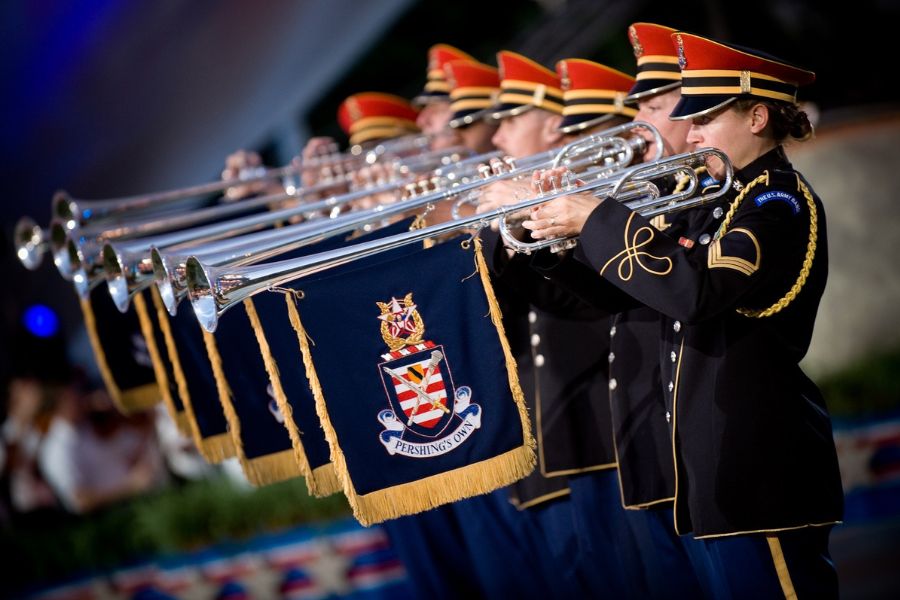
- Online course: How to Compose a Fanfare
- Blog post: 5 Top Tips for Composing for Choir
- Online course: How to Modulate (learn to move to 12 different keys)
Note: all resources and courses are included in the Teacher Access Plan (better value!)
5. AoS 5: Programme Music (1820–1910)
Brief focus:
An orchestral composition celebrating Jacques Cousteau by depicting the underwater colours and marine life of the sea.
Decoding the brief
For this brief, students need to demonstrate technical control of instrumental techniques and timbre, and advanced harmonic vocabulary to evoke vivid marine pictures.
| Feature | Detail |
| Harmonic vocabulary | Chromaticism, whole-tone/octatonic scales for water imagery, extended chords and non-functional chords. |
| Structure | Possible narrative form (storyboard layout) with leitmotifs representing marine creatures or the sea environment. |
| Instrumentation | Expanded 19th-century orchestra: exploration of effects such as: harp glissandi, tremolo strings, woodwind techniques (flutter tonguing), muted brass, and shimmering percussion (glockenspiel/tam-tam). |
Exemplar listening
La Mer by Claude Debussy
Example of ‘fluid’ orchestral textures, timbral colour (muted brass, clarinet melodies, cor anglais etc.) and water imagery.
Scheherazade (Mvt. I: The Sea and Sinbad’s Ship) by Nikolai Rimsky-Korsakov
Demonstrates leitmotif transformation and lyrical writing for strings and woodwind (listen out for the virtuosic violin solo punctuated by harp chords).
Sea Sketches by Grace Williams
A 20th century (1944) programmatic string suite demonstrating how extended string techniques and motif repetition/development can paint different states of water.
The Blue Planet by Hans Zimmer
This is a great example of descriptive music for the ocean. Students can explore the whole soundtrack (for Blue Planet I and II) to gain ideas for different creatures.
Vltava by Bedřich Smetana
The classic Romantic benchmark for depicting a river’s journey! Listen for the two flutes at the start, surging string motifs, and percussion at climactic moments.
Getting started activity
- Ask students to research the Great Barrier Reef – they could create a mood board with images (including Jacques Cousteau), and colour palettes.
2. Invite students to choose three sea creatures and write a theme for each (see Blue Planet above for inspiration).
Further resources:
- Online course: Composing for Instruments (Strings, Woodwind, Brass)
- Resource: Descriptive Music Listening Pack (includes Grace Williams)
- Blog posts: Advanced Harmonic Techniques series

Note: all resources and courses are included in the Teacher Access Plan (better value!)
6. AoS 6: Innovations in Music, 1900 to the present day
Brief focus:
This brief asks candidates to create an artwork-led composition, translating the structural, visual, or conceptual features of a specific chosen Hockney piece (such as colour contrast, joiner perspective, geometric line, or spatial repetition) into a deliberate, coherent sound world using any combination of acoustic or electronic forces.
Decoding the brief
For this brief, students need to have a strong concept. They should confidently use musical features/processes to translate the artistic features, and show clear development within the composition.
| Feature | Detail |
| Harmonic vocabulary | Post-tonal palettes, polytonality, whole-tone/pentatonic sets, dissonance; ambient electronic modal pads. |
| Structure | Non-linear forms: musical collage (montage technique – Stravinsky), minimalist additive structures, spatial panning loops. |
| Instrumentation | Extended instrumental techniques (e.g. prepared piano, bow on cymbal etc.), live synthesis, field recordings, and spatial audio manipulation. |
Exemplar listening
Electric Counterpoint by Steve Reich
This example mirrors Hockney’s visual ‘joiner’ collages through interlocking phase-shifted minimalist guitar loops.
Varmints – Nautilus by Anna Meredith
This example demonstrates vibrant, colourful blends of acoustic brass/strings with synth processing and driving rhythms.
Toward the Sea by Toru Takemitsu
An excellent example of translating spatial visual art and water concepts into delicate acoustic textures. Look closely at the writing for alto flute and guitar and the interaction between the two instruments.
Getting started activity
- Choose a Hockney painting (e.g. A Bigger Splash – 1967) and assign specific musical features to visual elements (e.g. sudden staccato cluster for the splash, drone for the pool).
- Sample an acoustic instrument, process it with reverse delays/pitch shifting, and layer it over synth textures to create a multi-layered ‘sonic artwork’.
Further resources:
- BCMG resources: Composing with Contemporary Music
- Inspiration page (free): Petrushka by Stravinsky (uses montage technique).