Welcome to the 2027 GCSE Music Composition Board-Set Brief Blog series.
The release of the exam board set briefs on 1st September always brings a mix of anticipation and a sudden urge to get planning. Whether your department is equipped with a full suite of DAWs, notation software, or a room of keyboards and acoustic instruments, guiding students through their briefs can feel like a balancing act.
This series is designed to save you time and give you some practical starting points. For each of the main exam boards we’ll break down the new briefs into clear, manageable components. Inside each guide, you’ll find overviews, exemplar listening lists, key pitfalls to avoid, and adaptable classroom starter activities tailored to whatever technology or instruments you have available.
Bookmark this page, grab a cup of tea, and explore the breakdown for your board to help your students hit the ground running this term.
This guide is designed for teacher planning and general skill-building prior to controlled assessment. In accordance with JCQ rules, the activities, suggestions and listening examples provided here must not be used as pre-prepared candidate work or model solutions for live NEA. This guide is not endorsed, affiliated with, or approved by OCR. Always refer to the official specification and JCQ guidelines for definitive assessment requirements. Briefs are accessed through the exam board secure portal.
Please read the OCR Composition Brief guidance carefully – students must choose a stimulus (sometimes stipulated for the AoS) and actively develop it within their piece.
At a glance summary
| Area of Study | Brief focus | Allowed Stimuli | |
| Brief 1 | AoS 2: The Concerto Through Time | Piece for solo instrument with accompaniment for a school open evening. | Note Pattern 1 or Note Pattern 2. |
| Brief 2 | AoS 3: Rhythms of the World | World music piece of choice for a World Music Festival (requires supporting style info). | Note Patterns 1–2, Rhythmic Phrases 3–4, or Chord Sequence 8. |
| Brief 3 | AoS 4: Film and Video Game Music | Descriptive piece for a youth story-writing event (requires written narrative explanation). | Note Patterns 1–2, Short Story 5, or Image 6 (Moonwalker). |
| Brief 4 | AoS 5: Conventions of Pop | Song in a popular style for a student pop music event (requires song lyrics). | Rhythmic Phrases 3–4, Words 7, or Chord Sequence 8. |
Brief by brief breakdown
1. AoS 2: Concerto through Time
Brief focus:
Composing a piece for a solo instrument with accompaniment using one of the given note patterns as the starting point, designed for a school open evening.
Decoding the brief
Must feature a distinct solo line with an accompaniment. The chosen note pattern stimulus must be included in full and demonstrably developed/extended.
Freedom: Choice of solo instrument, accompanying ensemble size, and historical/modern style.
Exemplar listening
Spring (Allegro) by Vivaldi
Spring (Allegro) by Max Richter
A modern reimagining of Vivaldi’s ‘Four Seasons’. Ask students to compare the two – how has Richter added his own style while remaining faithful to the original piece?
Sicilienne, by Gabriel Faure
A clear solo/accompaniment example demonstrating a lyrical solo woodwind melody supported by a legato broken-chord accompaniment.
4 Sketches: Dreaming by Amy Beach
An example of a romantic cello and piano composition, with expressive solo melody accompanied by gentle, legato broken chords on the piano.
Triptyque by Henri Tomasi
An advanced, virtuosic 20th-century piece demonstrating how intense chromaticism, rapid finger work, and dialogue between solo trumpet and piano create dramatic tension.
Getting started activity
Invite students to write down their chosen note pattern. Brainstorm what could be done with the note pattern e.g. retrograde / inversion and so on. Ask them to play the notes and improvise, using different rhythms, octaves and keys (can they transpose it?).
Watch out for:
Equal parts: Writing a duet where both parts have equal importance, losing the clear ‘soloist & accompaniment’ concerto relationship.
Unaltered stimulus: dropping the note pattern in once at the start and never repeating, varying, or developing it again.
Further resources:
- Online course: How to Compose a Competition Piece (solo instrument & piano)
- Online course: How to Write a Piano Accompaniment
- Downloadable resource: Piano Accompaniment Patterns Resource
Note: all resources and courses are included in the Teacher Access Plan (better value!)
2. AoS 3: Rhythms of the World
Brief focus:
Composing a piece of world music using a note pattern, rhythmic phrase, or chord sequence stimulus, intended for a World Music Festival.
Decoding the brief
Students must clearly reflect a specific, named World Music tradition (e.g. Reggae, Samba, Bhangra, West African Drumming, Calypso). Must integrate the selected stimulus.
Required admin: Students must state the name of the world music style in their submitted documentation.
Exemplar listening
Djanffa by Kora Jazz Trio
A vibrant instrumental composition demonstrating how West African kora (harp-lute instrument) melodies combine with jazz piano improvisation and syncopated drumming to build energy.
Mas Que Nada by Sergio Mendes feat. Black Eyed Peas
Demonstrates traditional Brazilian samba rhythm patterns, syncopated acoustic guitar chords, and call & response vocals, fused with rapped vocals.
Toast by Koffee
An energetic example of reggae fusion, demonstrating offbeat guitar chords, and prominent syncopated bass line.
Suggested classroom activity
Ask students to explore the stylistic rhythms of their chosen style and experiment with layering different patterns, as a starting point. Plan the other features that will make the style of their composition recognisable e.g. instrumentation and melodic motifs based on particular scales/modes.
Watch out for:
Generic western pop: submitting a standard pop track without including authentic stylistic features of the chosen world music style.
Missing style label: Forgetting to write the name of the chosen tradition on the cover/submission form.
Further resources:
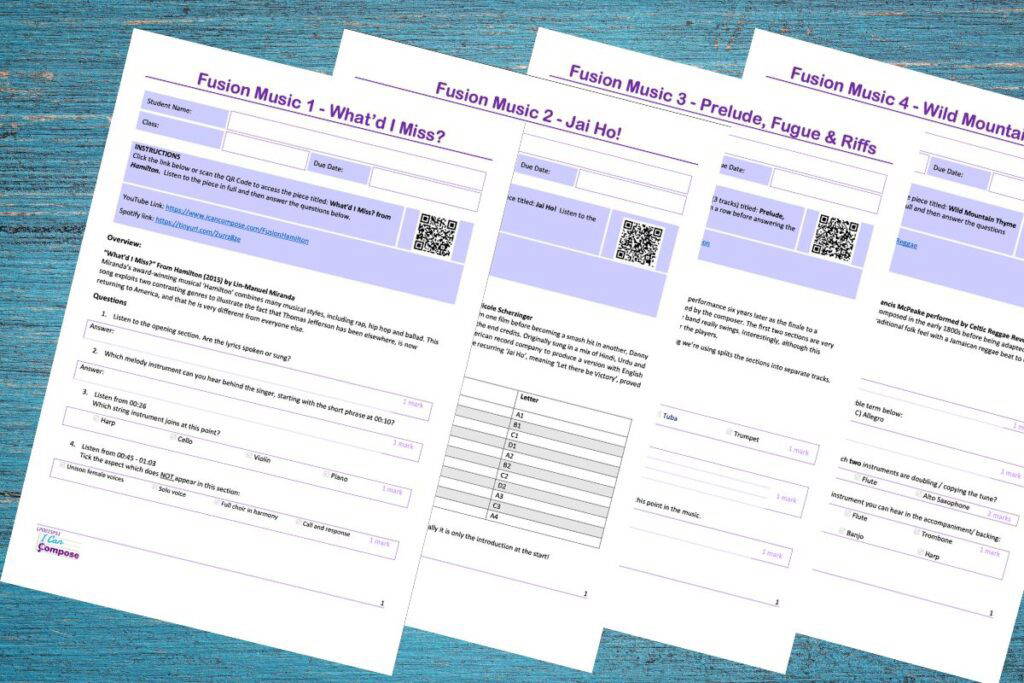
- Fusion Music Listening Pack
- Free Inspiration page with Indo-Jazz; Funk and Mahlian Fusion
Note: all resources and courses are included in the Teacher Access Plan (better value!)
3. AoS4: Film
Brief focus:
Composing a descriptive piece of film music using a note pattern, the short story prompt, or the astronaut/moonwalk image prompt, intended for a youth story-writing event.
Decoding the brief
Must convey a clear story or visual mood. Requires written supporting documentation outlining the story, continuing the text prompt, or explaining how the image was mapped musically.
Stimulus focus: Image 6 shows an astronaut on the moon looking back at Earth; Story 5 describes a sunset in a peaceful woodland where shapes begin to appear.
Exemplar listening
Day One from Instellar by Hans Zimmer
An excellent reference for sparse, atmospheric synth/organ textures capturing the vastness of space.
Call me Joker from Joker by Hildur Guðnadóttir
An example of how to use layered strings and rhythmic ostinati to build atmospheric tension.
Building the Crate from Chicken Run by John Powell
Great for illustrating action, narrative movement, and clear storytelling through orchestral cues.
Suggested classroom activity
Plan the timeline: As a starting point, ask students to divide their composition into 3 distinct visual sections (e.g. Section A: Peaceful/Spacious, Section B: Unexpected event/tension, Section C: Resolution) and assign instrument section, key, dynamic/tempo mark to each.
Watch out for:
Unclear structure / focus: Writing lots of musical ideas / layers, without a clear structure or thematic motif.
Omitted documentation: Failing to attach the required written narrative/description explaining the link between the music and the visual/text stimulus.
Further resources:
We have a wealth of blog posts dedicated to film music:
Note: all resources and courses are included in the Teacher Access Plan (better value!)
General Admin & Submission Checklist
- Duration requirements: The combined duration of both compositions (Free + Brief) must be at least 3 minutes in total.
- Score / Documentation Requirements: Submissions require an audio recording paired with a score, lead sheet, written account, or annotated full-colour DAW screenshots.
- Authentication & monitoring: Teachers must log 3 milestone progress reviews and supervise final exports in school to sign off the mandatory JCQ authentication form.