Welcome to the 2027 GCSE Music Composition Board-Set Brief Blog series.
The release of the exam board set briefs always brings a mix of anticipation and an urge to get planning!
This series is designed to save you time and give you a practical starting point. For each of the main exam boards, we’ll break down the new briefs into clear, manageable components. Inside each guide, you’ll find overviews, exemplar listening lists, key pitfalls to avoid, and adaptable classroom starter activities.
Bookmark this page, grab a cup of tea, and explore the breakdown for your board to help your students hit the ground running this term.
This guide provides independent teaching ideas by I Can Compose and is not endorsed, affiliated with, or approved by WJEC. Always refer to the official specification and JCQ guidelines for definitive assessment requirements.
The briefs have been summarised here, they cannot be displayed in full, under JCQ rules – please log into the secure exam portal to download the official briefs.
At a glance summary
| Topic / context | Key points | |
| Brief 1 | Image of Llyn Llydaw, Yr Wyddfa (Snowdonia) | Programmatic / Visual; open instrumentation; focus on texture & contrast. |
| Brief 2 | ‘All Things Welsh’ event at Caerphilly Castle | Ceremonial / Formal; brass/orchestral or folk ensemble; clear ternary/binary structure |
| Brief 3 | Opening of the new Kop Stand at Wrexham AFC | Commemorative / stadium anthem; rock/pop/brass band; driving rhythms or celebratory instrumental piece. |
| Brief 4 | Honouring Welsh jazz singer & activist Patti Flynn | Jazz / Swing / Soul; solo voice/instrument with jazz backing; 12-bar blues or AABA |
Brief by brief breakdown
1. Snowdonia landscape
Summary of brief:
Composing a piece of music inspired by the image provided (see brief document).
Decoding the brief
- This is a visual and programmatic brief which focuses on musical storytelling and atmospheric contrast.
- The image contrasts the still, deep waters of Llyn Llydaw with the majestic peaks of Yr Wyddfa.
- Freedom: flexibility over instrumentation, ensemble size, and structural form.
Exemplar listening
1. Mysterious Mountain from Symphony no.2 by Alan Hovhaness
- Demonstrates how expansive string writing, sustained brass chords & celeste (adding sense of magic) portray the vastness and grandeur of mountain peaks.
2. Celtic Dances by William Mathias
- This example shows how repeated motifs (listen out for the harp and glock) can be developed with longer more lyrical phrases over the top (e.g. strings).
3. Penillion for Orchestra (Mvt. I: Moderato cantando) by Grace Williams
- This piece is a great demonstration of how passing a melodic theme across woodwinds, strings, and brass over harp arpeggios creates timbral contrast and a sense of landscape grandeur.
Getting started activity
Ask students to brainstorm how they can musically represent a mountain (using ideas from the exemplar listening) and a lake. How might they use the musical elements (e.g. dynamic and textural build up) to portray these landscape features?
Can they compose a ‘mountain theme’ and a ‘lake theme’? What do they need to include to effectively convey these?
Set a short practical activity where students improvise with a sustained open fifth drone and repeating arpeggiated motif.
Focus on: texture
- Be intentional about the texture – map out where the climactic point (the mountain peak!) will be reached.
- How will the music build to this point?
Focus on: instrumentation
- Spend time planning the instruments.
- Which instruments will convey the lake and the mountain?
Watch out for:
Composing aimless ‘background music’ that lacks a clear structure or harmonic foundation. Ensure they map out a definitive form to avoid a meandering, directionless composition.
Further Resources:
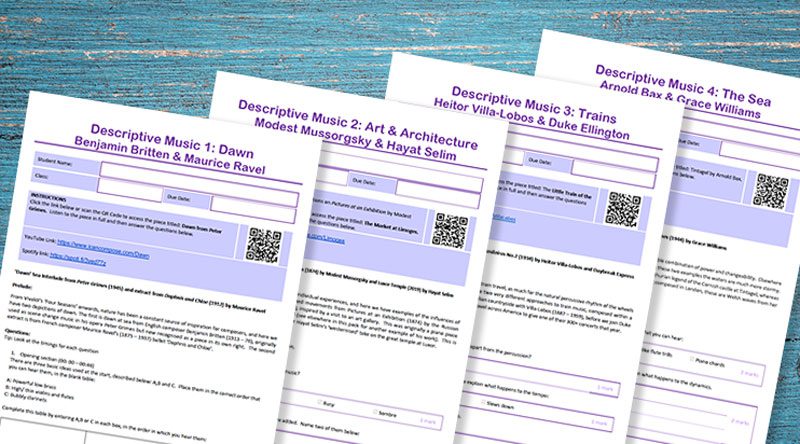
Descriptive Music Listening Pack: Student listening sheets on a variety of descriptive pieces.
Inspiration page. (free): students can explore this diverse library of listening pieces with insights and prompts.
Note: all resources and courses are included in the Teacher Access Plan (better value!)
2. Caerphilly Castle Event
Summary of brief:
Composing a piece of music for a formal event called ‘All Things Welsh’ at Caerphilly Castle”.
Decoding the brief
This brief demands a ceremonial, dignified, or festive character suited to a grand historical landmark. The piece needs a sense of arrival and occasion. Suggested suitable styles include a brass/orchestral fanfare, a stately march, or a modernised Welsh folk dance. As the event is called ‘All Things Welsh’, students need to consider how they will bring in Welsh features e.g. through instrumentation, folk tunes etc.
Exemplar listening
Men of Harlech (Traditional)
- Traditional Welsh theme played by brass band.
- Students can draw on this through composing a similar melody with regular, even phrases and simple rhythm.
Listen to this arrangement after listening to the ‘original’:
Men of Harlech (arranged by Alex McGee)
Investiture Anniversary Fanfare by William Mathias
- Commissioned for the 1969 Investiture at Caerphilly’s neighbouring Caernarfon Castle, this is a quintessential ceremonial Welsh fanfare.
- It features crisp, overlapping repeated trumpet calls, punchy trombone lines, and snare drum rolls.
- Notice the contrast when the percussion drops out.
Tale of Two Dragons by Calan
- Demonstrates how traditional Welsh instruments can be layered over a steady rhythm to build a sense of historical drama and noble arrival.
Suggested classroom starter activity
Write a 2-bar fanfare motif using primary triads – I, IV and V – and dotted and triplet rhythms. Students could start with a ‘question’ phrase, followed by an ‘answer’ phrase (see further resource below for more details).
Watch out for:
If writing in a fanfare style: brass compositions can become repetitive or tiring for the players, if written at a constant forte dynamic. Remind students to build in contrast through a quieter B-section, featuring woodwinds or solo strings before returning to the main fanfare theme.
Further resources
Online course: How to Compose a Fanfare. Step-by-step guidance on writing an effective fanfare motif and building into a full composition.
Free Inspiration page: look particularly at Fanfare for the Common Man by Copland.
Note: all resources and courses are included in the Teacher Access Plan (better value!)
3. Wrexham AFC Kop Stand
Summary of brief:
Composing a piece of music to commemorate the opening of the new Kop Stand at Wrexham AFC.
Decoding the brief
This brief calls for an energetic, celebratory atmosphere, so responses could include: a stadium anthem, fast pop/rock/brass piece or upbeat fanfare.
Key requirements are a driving rhythmic pulse, a memorable melodic hook that could (perhaps) function as a crowd chant, and an uplifting harmonic structure.
Exemplar listening
1. Castell Coch March
- Demonstrates how a driving brass rhythm, crisp snare rolls, and lyrical cornet melody can create an energetic atmosphere.
- Listen at 1:52 to the change of section, into a major key and lighter texture.
2. Seventeen Going Under by Sam Fender (Clean version)
- Demonstrates an uplifting vocal line (notice how the pitch ascends at the end of the melodic phrases).
- Driving 4/4 beat creates momentum.
- Listen out for the guitar ostinato which builds throughout.
3. You’ll Never Walk Alone by Gerry & The Pacemakers
- This is a classic model for building a song from a very quiet, lyrical opening into a full-sounding climactic song.
- Notice the sudden cut at 2:26.
Suggested classroom activity
Students can create a 4/4 driving drum pattern (four-on-the-floor kick with a strong snare on beats 2 & 4). See resource below for further details.
Compose a 4-bar diatonic chord sequence using I, IV, V, vi. Use inversions to create a smoother bass line and consider including added 7ths to create interest.
Compose a step-wise, singable melody using the chord sequence as a basis.
Watch out for:
Too much repetition: suggest that students consider including a bridge section with a change of key and/or contrast in texture (e.g. bass and vocals only) before the final section/chorus.
Further resources:
Online courses:
Resource: Writing Effective Drum Parts downloadable booklet with audio
Note: all resources and courses are included in the Teacher Access Plan (better value!)

4. Patti Flynn tribute
Summary of brief:
Composing a piece of music to honour the life of Welsh jazz singer and social activist, Patti Flynn.
Decoding the brief
This brief honours Cardiff-born jazz vocalist, author, and social activist Patti Flynn. The composition should reflect jazz, swing, blues, or soul traditions. Students could compose an instrumental jazz track (e.g. saxophone or piano lead with a rhythm section) or a vocal jazz ballad using suitable lyrics.
Exemplar listening
Baubles, Bangles and Beads sung by Patti Flynn
- An example of Patti Flynn’s swing vocal style, walking basslines, and traditional jazz trio arrangement.
St Thomas by Sonny Rollins
- This example models how students can incorporate Afro-Caribbean rhythmic patterns, syncopated head melodies, and melodic motifs to celebrate the rich multicultural jazz heritage of Cardiff’s Tiger Bay.
Watermelon Man by Herbie Hancock
A useful reference for using a 16-bar structure, syncopated riff motifs, and clear instrumentation dialogue (listen to those solos!).
Suggested classroom activity
Ask students to research Patti Flynn and listen to her recordings (there’s a YouTube channel called Cardiff Music History that’s worth a look).
Students can create a jazz chord progression (avoid using 12-bar blues – see below).
They might find this video a useful starting point:
Once they’ve got a solid harmonic structure, they can begin to improvise a vocal melody over the top.
Watch out for:
Jazz compositions can become ‘muddy’ if students overload the texture. Ensure that each line is intentional and has its place.
Exam boards often advise against using a 12-bar blues structure so encourage students to create their own harmonic sequence.
Further resources:
Online course: How to Compose a Pop Song take students through writing a ballad and includes sections on writing backing vocals.
Online course: How to Write a Piano Accompaniment
Resource: Piano Accompaniment patterns
Note: all resources and courses are included in the Teacher Access Plan (better value!)

General Admin & Submission Checklist
- Combined duration: Total length across both submitted compositions (Free + Brief) must be between 3 and 4 minutes.
- Score & documentation: A score or a fully annotated lead sheet or a detailed written description of the music and anoutline of the melody and chords used.alongside the MP3 audio recording.
- Controlled Conditions & logging: Teachers must supervise composition hours in school and sign off on authentication logs at key milestones.
- Students must complete and sign a non-assessed composition log (template on WJEC website). This should contain details of the composition process, any non-original materials, such as musical quotes, software packages used, any musical influences you may have used how the recording was achieved.