Welcome to the 2027 GCSE Music Composition Board-Set Brief Blog series.
The release of the exam board set briefs on 1st September always brings a mix of anticipation and a sudden urge to get planning! Whether your department is equipped with a full suite of DAWs, notation software, or a room of keyboards and acoustic instruments, guiding students through their briefs can feel like a balancing act.
This series is designed to save you time and give you a practical starting point. For each of the main exam boards – AQA, Edexcel, Eduqas, WJEC and OCR – we’ll break down the new briefs into clear, manageable components. Inside each guide, you’ll find overviews, exemplar listening lists, key pitfalls to avoid, and adaptable classroom starter activities.
Bookmark this page, grab a cup of tea, and explore the breakdown for your board to help your students hit the ground running this term.
This guide is designed for teacher planning and general skill-building prior to controlled assessment. In accordance with JCQ rules, the activities, suggestions and listening examples provided here must not be used as pre-prepared candidate work or model solutions for live NEA. This guide is not endorsed, affiliated with, or approved by Edexcel. Always refer to the official specification and JCQ guidelines for definitive assessment requirements. Briefs are accessed through the exam board secure portal.
At a glance summary
| Area of Study | Brief focus | |
| Brief 1 | AoS 1: Instrumental Music 1700–1820 | Ground bass theme, solo instrument + accompaniment; wedding setting. |
| Brief 2 | AoS 2: Vocal Music | Solo voice + accompaniment, iconic venue/event setting. |
| Brief 3 | AoS 3: Music for Stage & Screen | Curtain-raiser / overture, sets scene for stage show. |
| Brief 4 | AoS 4: Fusions | Blends Western Classical + Rock, promenade concert setting. |
Brief by brief breakdown
1. Instrumental Music 1700 – 1820
Brief focus:
Developing and extending a ground bass theme to be performed at a wedding.
Decoding the brief
Composition must be based on a repeating ground bass theme (original or existing) that is developed and extended throughout. Requires a clear distinction between a solo lead line and accompaniment suitable for a wedding.
Instrumentation: solo instrument + accompaniment (acoustic, amplified, or synth). Accompaniment can be for one or more instruments.
Style: the music can be in any style.
Exemplar listening
Music for a While by Henry Purcell
Perhaps an obvious choice, but clearly demonstrates a 3-bar ascending ground bass supporting expressive solo ornamentation and variation.
Canon in D by Johann Pachelbel
A very well known example! It demonstrates the celebrated 8-note, major-key ground bass that repeats unvaried beneath a number of progressive variations.
There are plenty of other pieces which have used this ground bass as a framework – this would make a useful comparative listening task.
Passacaglia in G minor by Handel/Halvorsen
Here Norwegian composer Johan Halvorsen took a simple 4-bar ground bass from a Handel harpsichord suite and arranged it into a virtuosic Romantic duet for violin and viola.
It showcases how an ostinato bassline can support dynamic build-ups, double-stopping, and rhythmic variations.
For variation techniques:
Eliza’s Aria by Elena Kats-Chernin
An uplifting (remember this brief is for a wedding!) contemporary piece built on a light, bouncing 4-bar piano ostinato.
Above a repeating harmonic frame, the violin leads variations which build in complexity, adding layers, register shifts, and decorative counter-melodies.
A Time to Love by Ben Dunnett
A short theme and variations example:
- Theme (repeated): up to 00:53
- Variation 1: 00:55
- Variation 2: 01:46
- Theme returns: 02:41
Getting started activity
Invite students to compose an 8-note ground bass pattern. It’s a good idea to start with an 8-chord sequence (think about implications on atmosphere of maj / min / dim / aug chord choices) . Ask them to write three separate variation sections above it using notes derived from the chord sequence:
- Variation 1: Crotchet (Quarter-note) melody.
- Variation 2: Quaver (Eighth-note) running arpeggios.
- Variation 3: Dotted rhythms/syncopation
Watch out for:
Wedding occasion suitability: the composition should be reflective or celebratory, therefore students should avoid composing a very solemn or melancholic piece. They should bear this in mind if they’re using an existing ground bass theme.
Static accompaniment: repeating the same upper melody over the ground bass without adding ornamentation, rhythmic variation, or counter-melodies.
Further resources:
Online course: How to Compose a Great Melody (includes development techniques)
Online course: How to Compose a Theme & Variations (for variation techniques)
Online course: Ready to Compose (melody – harmony – rhythm)
All courses and resources are included in the Teacher Access Plan (better value!)

2. Vocal Music
Brief focus:
Composing a song for solo voice and accompaniment in a form of your choice, to be performed at an iconic venue or event.
Decoding the brief
Context: Vocal Songwriting / Pop / Musical Theatre / Art Song.
This composition must feature a single solo vocal lead with instrumental accompaniment and demonstrate clear structural shape (e.g. Verse-Chorus) and showcase vocal technique (range, dynamics, word-painting) fitting a high-profile venue.
Instrumentation: Voice + any acoustic/electronic backing.
Exemplar listening
Skyfall by Adele
Demonstrates how to exploit vocal range, melodic development through use of widening intervals (chorus) and use of simple but effective piano accompaniment (with additional instruments as song builds).
Somebody to Love by Queen
Demonstrates clear verse-chorus structuring, expressive vocal phrasing, and dialogue between solo voice and backing vocals.
Dog Days are Over by Florence + The Machine
An example of driving acoustic accompaniment and textural build up. Notice the hand claps, harp and percussion.
Suggested classroom activity
Planning: Brainstorm iconic venues, e.g. Royal Albert Hall in London or the Glasshouse International Centre for Music in Gateshead, and events such as the BBC Proms or Glastonbury. If students have a real venue and event in mind, it will help to bring their composition plans to life.
Watch out for:
Unsingable vocal lines: students should make sure they (or someone else) sing their vocal line to check that there are no awkward intervals or word-setting.
Lack of word painting: Treating lyrics as an afterthought with no correlation between text meaning and melodic shape/dynamics.
Further resources:
Online course: How to Compose a Pop Song
Online course: How to write a Piano Accompaniment
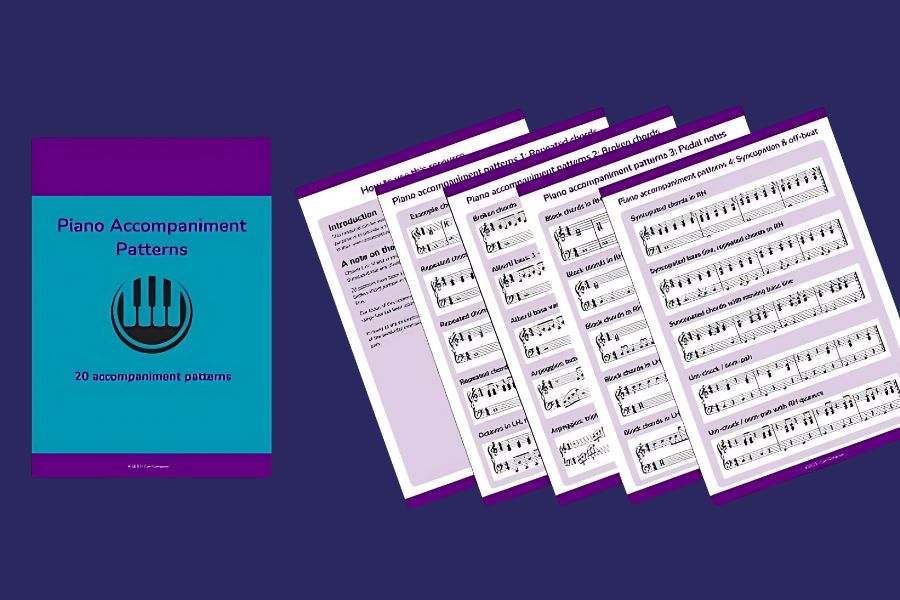
Downloadable resource: Piano Accompaniment Patterns Resource
All courses and resources are included in the Teacher Access Plan (better value!)
3. Music for Stage & Screen
Brief focus:
Composing music to be performed before the curtain rises at the start of a stage show.
Decoding the brief
The composition must act as a ‘curtain-raiser’ (overture) that establishes character motifs, mood, and dramatic tension before the show begins. It requires clear thematic contrast (e.g. hero motif vs. villain motif).
The composition can be in any style and use one or more instrument(s).
Exemplar listening
Overture to Wicked by John Powell and Stephen Schwartz
Combines contrasting thematic motifs, chromatic chords, and sudden tempo changes to build anticipation before the curtain rises.
Elizabeth Remembers by Debbie Wiseman
Demonstrates building melodic themes and lyrical solo woodwind/string writing. This was originally composed as a tribute to Queen Elizabeth II.
Overture to Candide by Leonard Bernstein
Fast-paced orchestral overture – a thematic medley with syncopated driving rhythms.
Suggested classroom activity
Students could plan two contrasting 4-bar character themes:
- Motif A (Hero/Noble): Major key, ascending brass intervals, 4/4 march pulse.
- Motif B (Villain/Mystery): Minor key, descending woodwind/string stabs, irregular metre.
- They could compose an 8-bar transition that blends both motifs together as the prelude builds to its final curtain-rising cadence.
Watch out for:
Unstructured soundscapes: Creating endless background music without distinct, memorable themes or musical development.
Abrupt cuts: Stitching unrelated musical ideas together without smooth transitions or harmonic bridges.
Further resources:
Online course: Ready to Compose (includes composing a character theme)
Free Inspiration page to explore further pieces.
All courses and resources are included in the Teacher Access Plan (better value!)

4. Fusions
Brief focus:
Combining the musical features of Western Classical Music and Rock to create a piece for performance at a promenade concert.
Decoding the brief
This composition must explicitly blend elements from Western Classical (e.g. orchestral strings/brass, contrapuntal textures, pedal points, classical structures like ternary or rondo) with Rock (e.g. electric guitar riffs, power chords, driving 4/4 drum backbeats, distortion).
- Can write for one or more instrument(s).
- The instrument(s) may be acoustic and/or amplified and/or synthesised.
Exemplar listening
Roll Over Beethoven by the Electric Light Orchestra (Glastonbury live)
Blends Beethoven’s 5th Symphony motifs with driving rock guitar riffs and 4/4 backbeat drums.
Concerto for Group and Orchestra by Deep Purple
Demonstrates call-and-response dialogue between a classical orchestra and a rock section (e.g. 03:17)
Butterflies & Hurricanes by Muse
This example combines virtuosic piano arpeggios (01:19) and orchestral strings with heavy rock bass lines and drum grooves.
Suggested classroom activity
As a starting activity, students can take a famous classical motif (e.g. Bach’s Toccata and Fugue in D minor or Vivaldi’s Summer). They can arrange the main classical melody for solo violin, synth, or lead guitar, while placing a driving rock rhythm section underneath (distorted bass power chords + 4/4 drum backbeat with snare on beats 2 and 4).
Watch out for:
Superficial fusion: Adding a basic drum beat behind a classical piece without altering the harmony or texture to genuinely incorporate rock conventions.
Further resources:
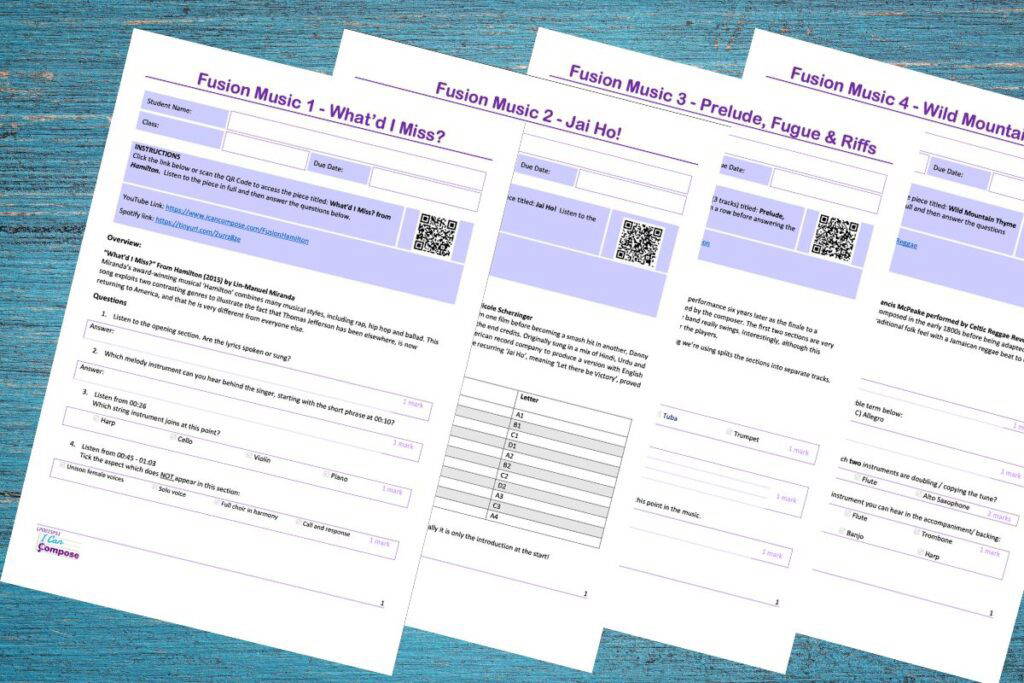
Listening Pack: Fusion Music
Online course: How to Compose a Great Melody
All courses and resources are included in the Teacher Access Plan (better value!)
General Admin & Submission Checklist
- Duration requirements: Each composition must be at least one minute in duration, and the total of both compositions (free and brief) must last a minimum duration of three minutes.
- Score / Documentation Requirements: Submissions require an audio recording paired with a score, lead sheet, written account, or annotated full-colour DAW screenshots.
- Authentication & monitoring: Teachers must log milestone progress reviews and supervise final exports in school to sign off the mandatory JCQ authentication form. The final write-up and recording of the composition must be completed under teacher supervision.