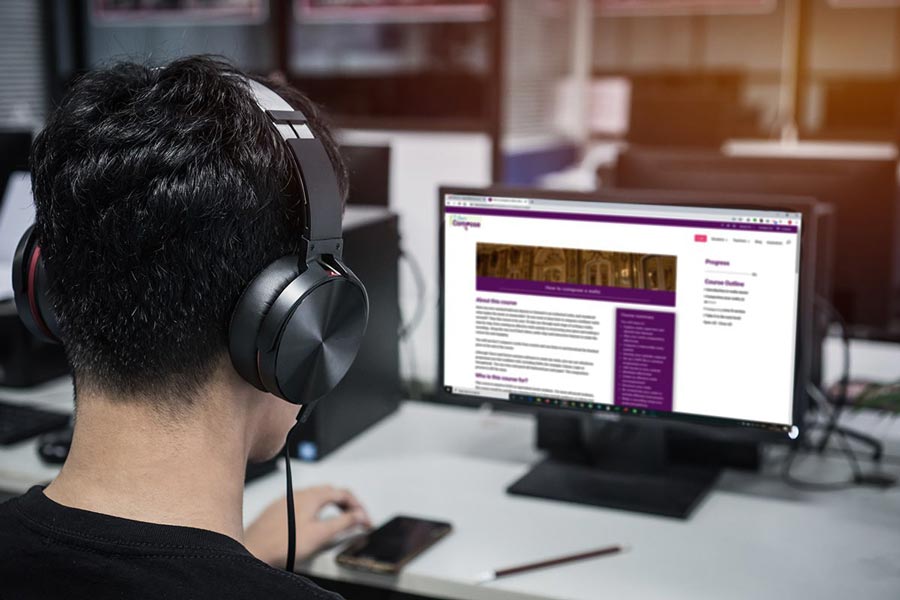
Introducing a new digital platform into the secondary music classroom can feel daunting, particularly when juggling composition deadlines, varying levels of prior musical literacy, and limited curriculum time. The I Can Compose Classroom Access Plan is designed to give students structured, step-by-step guidance in music composition, freeing you up to offer targeted one-to-one feedback.
If you’re setting up a new cohort – whether at KS3, GCSE, A level or MYP – here’s a practical framework for mapping out your students’ learning pathways and getting the most out of the I Can Compose platform.
1. Mapping Out a Suggested Student Pathway
Because students have access to the entire course library, providing a clear starting point prevents overwhelm and builds early confidence. A structured progression can work well across different key stages:
- Phase 1: Start younger students with accessible, engaging mini-courses such as Composition – How to Get Started! and How to Compose Video Game Music. At 20-30 minutes, How to Get Started! introduces practical creative stimuli, such as mood boards, scales, rhythmic motifs, and chord sequences, helping hesitant composers generate initial ideas without the pressure of producing a finished piece. Pairing this with Video Game Music hooks Year 7 and 8 learners immediately through a familiar, exciting medium.
- Phase 2: Building Core Craft (KS3 & Year 9 Options) Once students understand how to generate initial ideas, move them onto targeted technical modules that develop specific musical elements. Courses such as How to Add Chords to a Melody, Composing a Melody using the Defining Feature Approach®, and How to Write a Piano Accompaniment allow Year 8 and Year 9 students to strengthen their harmonic and melodic control ahead of choosing their GCSE options.
- Phase 3: Bridging to GCSE & Exploring Genre (Start of Year 10 & Year 11) At the start of Year 10, transition your GCSE cohort onto Ready to Compose. This foundational course formalises their understanding of rhythm, triads, cadences, melody writing, and basic development, ensuring every student shares a solid technical baseline before tackling exam coursework. From there, students can branch out into stylistic briefs like How to Compose a Pop Song, Heroic Film Music, or Theme & Variations to support their free or brief-set compositions.
- Phase 4: Refining and Stretching (Late GCSE & A-Level) For your most confident students or sixth-form cohorts, advanced technical courses such as Composing for Instruments, How to Modulate, and How to Compose a Competition Piece offer deeper insight into idiomatic writing, extended techniques, and structural sophistication.
3. Student Choice vs. Whole-Class Study
One of the main pedagogical decisions you’ll face is whether to have the whole class work through the same course simultaneously or allow students to choose their own pathways. Both approaches have distinct merits:
| Approach | Pros | Cons |
| Whole-Class Pathway | • Easier to deliver whole-class starters, plenaries, and shared listening. • Keeps assessment straightforward when marking everyone against the same brief. • Ensures every student covers essential foundational theory. | • Faster workers may feel held back. • Less confident students can feel anxious if they fall behind the class pace. • Limited room for individual musical interests. |
| Student-Selected Courses | • Boosts intrinsic motivation and ownership over coursework. • Naturally differentiates for mixed-ability classes and varied instrumental backgrounds. • Mirrors the autonomy required for working on exam composition briefs. | • Harder to monitor progress across numerous different projects simultaneously. • Requires stricter deadlines to prevent students “course-hopping” without finishing tasks. |
A balanced middle ground: you could use a whole-class approach during Phase 1 and Phase 2, then open up student choice in Phase 3 when pupils begin to draft their individual coursework pieces.