If your students’ composition marks were unexpectedly reduced in recent series, you’re not alone in seeking greater clarity for the coming cohort. To help guide your students toward top bands, I’ve been reading through the Non-Examined Assessment NEA composition feedback from the latest AQA (2023), Eduqas (2025), OCR (2025), and WJEC (2025) Principal Examiners’ and Moderators’ reports.
I was recently asked what one key take-home piece of advice I would give to teachers preparing their students for the composing component of GCSE Music, and it’s this:
Allow enough time to create solid ‘building blocks’ – chord sequence; melodic theme with a strong rhythmic identity. If these are in place, they will be much easier to develop later in the composition.
So, here are 5 essential teaching strategies – each expanded with three actionable classroom steps – based on examiner feedback across four major examination boards.
1. Prioritise Musical Development Over Repetition & Layering
Across AQA, Eduqas, OCR, and WJEC, moderators report that mid-to-lower mark bands are overwhelmingly dominated by repetition, unvaried block copying & pasting, and use of loops. OCR and WJEC specifically warn against Digital Audio Workstation (DAW) ‘block layering’, where students simply add or subtract tracks rather than developing musical ideas.
- Teach structured motif development: guide students to extend initial ideas using techniques like melodic variation, countermelodies, augmentation, and modulation rather than repeating 2 or 4 bar phrases.
- Differentiate texture from development: remind students that adding or removing DAW tracks alters texture but doesn’t demonstrate true compositional development of melodic or rhythmic material.
- Craft purposeful conclusions: melodic phrasing and cadences! Encourage written or planned musical closures rather than abrupt stops or digital fade-outs, which examiners across all boards consistently criticise for failing to demonstrate technical control.
Classroom Activity
4 bar motif transformation
To help students move away from unvaried DAW block copying & pasting, you can set a challenge where they develop a short 2-bar or 4-bar melodic motif through four variations, without adding new instrument tracks. They could do this on an ‘Ideas Page’ a bit like they might do in an Art lesson where they’re trying out different painting techniques.
I would first model this at the front with a short motif, then give students a different motif (perhaps in a template) to try the techniques themselves.
- Rhythmic variation: double or halve the note values (augmentation/diminution) or use syncopation.
- Melodic development: use inversion, retrograde, pitch transposition, or decorative passing notes.
- Change key & reharmonise: move the motif into the relative major/minor or compose a countermelody.
- Concluding the phrase: ask students to create a 2-bar ending with a clear cadential resolution rather than a fade-out or sudden stop.
Further resources
Online course: Ready to Compose takes students through the key building blocks: Melody, Rhythm and Harmony with practical tasks, clear examples and mini composition projects.
Free resource: Getting Started with Teaching GCSE Composition

Note: All courses and resources are included in the Teacher Access Plan (better value!)
2. Improve Harmonic Coherence and Melodic Phrasing
Harmonic incoherence remains one of the most frequent technical errors flagged across all exam boards. Lower-scoring pieces often rely on repetitive root-position chord sequences or unshaped melodies with unintended dissonances. Both OCR and WJEC note that top-band marks require high-quality melodic writing paired with a rich, coherent harmonic language.
- Focus on voice leading and cadences: teach students how chord inversions, functional bass lines, and clear cadences can remove awkward dissonances and support the melodic flow.
- Structure phrases intentionally: practise writing balanced, antecedent-consequent (‘question and answer’) phrases over set chord progressions before expanding into more ‘free’ compositions.
- Avoid chord progression clichés: remind students that relying on unvaried 12-bar blues patterns or I-IV-V-I loops can restrict harmonic depth, unless paired with extended development techniques.
Classroom Activity
Voice-leading & cadences
What is voice-leading?
Voice leading is the skill of arranging chord changes so that the individual notes move smoothly from one to the next.
Give students an 8-bar chord progression and guide them through these three steps:
- Voice leading: convert (some) root-position chords into inversions, keeping common notes in the same octave to avoid awkward voice movement.
- Balanced phrasing: compose an 8-bar melody structured as two 4-bar phrases. Use notes from the chord sequence (on the strong beats) to map the melody. The first phrase could have an imperfect cadence (ending on Chord V), and the second must resolve with a perfect cadence (Chord V – I).
- Functional bass lines: replace static root notes with step-wise bass motion or passing notes leading into cadence points.
Chord sequences for everyone
Example 1: inversions + smooth bass line
In this example we have 4 chords: I – vi – IV – I in C major. We can write the notes out in a table, which clearly shows where the common notes are. We can create a one-note bass line through using inversions, which can then be developed into a rhythmic bass riff.
Sequence: I – vib – IVc – I

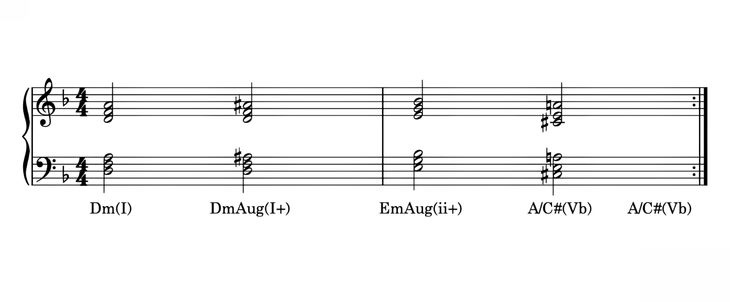
Example 2: diminished and augmented chords
A more sophisticated harmonic sequence will bring in ‘adventurous’ chords, such as added note, suspended, diminished and augmented chords:
Further resources
As above, our popular online course: Ready to Compose takes students through the key ‘building blocks’ and includeds writing chord sequences.
Online course: How to Compose a Great Melody
Online course: How to Add Chords to a Melody

Note: All courses and resources are included in the Teacher Access Plan (better value!)
3. Ensure Full Realisation of Briefs and Encourage Creative Independence
Examiners across AQA, Eduqas, OCR, and WJEC noted that candidates frequently miss key requirements of set briefs – such as omitting vocal lines in song-based briefs or failing to convey required descriptors like ‘exciting’ in film cues.
- Deconstruct brief parameters thoroughly: model how to annotate a set brief (you could use the previous year’s briefs as a ‘mock’ in Year 10) ensuring that students highlight each requirement for: specific audience, occasion, and stylistic intent.
- Avoid whole-class templates: refrain from giving entire cohorts identical structures, instruments, or chord progressions, as this can restrict individual creativity and negatively impact marks.
- Capitalise on key performance strengths: encourage students to work to their strengths, composing for their instrument or voice – writing for familiar instruments helps them generate and refine ideas more naturally.
4. Guide the Intentional Use of Music Technology
DAWs (Digital Audio Workstations such as Logic Pro, Cubase, Soundtrap, BandLab etc.) are fantastic tools for realising creative musical ideas, but examiners warn that pre-recorded loops, chord generators and automated drummers do not demonstrate student compositional control.
- Prioritise original creation over pre-made loops / motifs: encourage students to build their own drum tracks, programme original MIDI patterns, and edit multitrack textures.
- Declare all software tools and non-original material: ensure that students explicitly acknowledge any pre-existing loops, samples, or automated software functions in their logs to preserve authenticity.
- Refine production mixing and balance: teach basic volume and EQ mixing so that secondary accompaniments, heavy drum tracks, or automated effects do not drown out the main melodic lines.
Classroom Activity
Drum track & bass workshop
To prevent candidates from relying on pre-recorded loops, chord generators and auto-drummers, run a hands-on DAW session focused on the creation of original ideas:
- MIDI Drum Programming: students record an original drum groove in a MIDI grid, manually editing the velocity, quantisation, and fill variations instead of dragging in loops. Start with the 3 key parts: Kick (bass) drum, snare and hi-hat. Alternatively, they can play in the parts themselves (see resource below).
- Record a bass line: students record a 2 or 4 chord sequence then a bass line derived from the chords.
- Peer Mix Audit: in pairs, students listen to each other’s tracks to offer feedback and refinement suggestions.
Further resources:
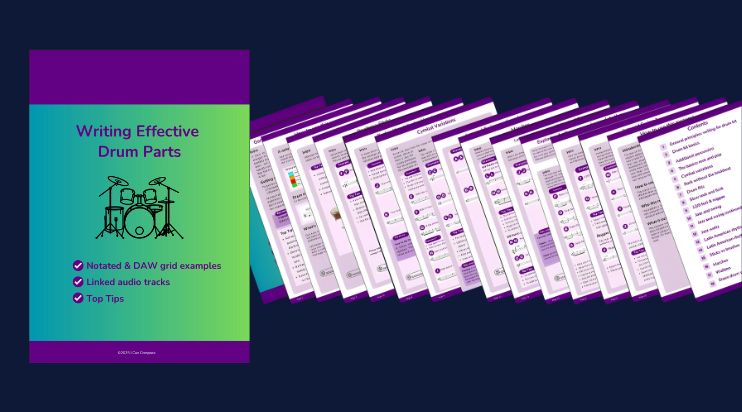
Resource: Writing Effective Drum Parts (booklet with audio)
Free blog post: Free Online Composing Tools for the Classroom
5. Triple Check the Coursework Documentation
A complete GCSE composition submission is evaluated through three equal components: audio recording, score / aural guide, and written log or evaluation.
- Annotate DAW screenshots thoroughly: straight project window screenshots on their own are insufficient; students must annotate DAW screenshots (aural guides) to explain the structure, tracks, chords, and custom editing techniques.
- Provide written notation or guide tracks for extra performers: if additional musicians perform on a candidate’s track, written notation or a recorded guide melody must be provided – verbal instructions or un-notated improvisation cannot be credited.
- Write focused logs and evaluations: ensure students complete clear programme notes (if required for your exam board) or detailed Candidate Logs and written Evaluations using precise musical vocabulary.
Check the requirements for your exam board as they are not all the same.
Supporting GCSE Music Students
I hope this article has provided some ideas and insights for delivering GCSE Music Composition. This part of the course isn’t easy! It requires creative courage, perseverance, technical control, and critical listening. By embedding these five strategies into your schemes of work, you can give your secondary music students the framework they need to flourish as confident, high-scoring GCSE composers!