Welcome to Part 2 of our 4 part series looking at Advanced Harmonic Vocabulary. In this article we’ll take a deep dive into Chromatic Mediants.
Chromatic mediants: what are they?
For students looking to capture an expansive, evocative sound reminiscent of modern film scores, chromatic mediants are a good option to explore.
Technical definition
Let’s first clarify what chromatic mediants and diatonic mediants are:
Chromatic mediants
Chromatic mediants are chords whose roots are related by a major or minor third, but which belong to different keys and share the same harmonic quality (both major or both minor). They share one common tone.
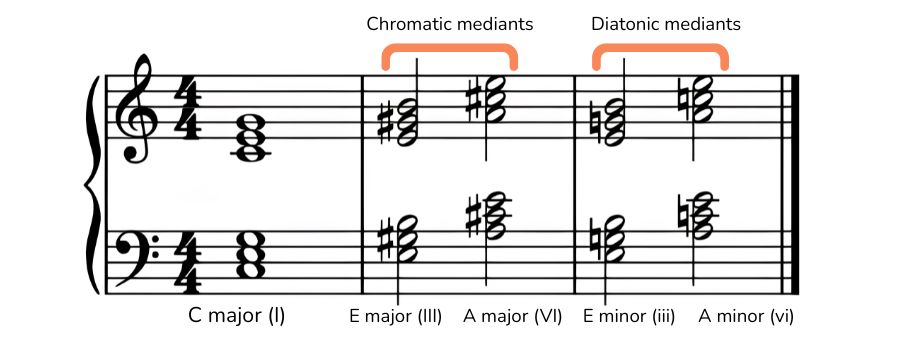
For example, in the key of C major, the chromatic mediant chords are E major or A♭ major.
Diatonic mediants
Diatonic mediants are chords with roots a third apart that remain within the home scale and have opposing qualities (e.g. major to minor and vice versa), sharing two common tones.
For example, in the key of C major, the mediant chords are E minor (iii) and A minor (vi).
In summary…
So, in standard diatonic harmony, a third away from the tonic chord of C major gives us E minor (iii) counting up from C, or A minor (vi) counting down from C.
These chords share one common tone with C major, and also contain accidentals foreign to the C major scale (see the G# and C# in the image below).
To transform these into chromatic mediants, the quality is altered so that they match the tonic:
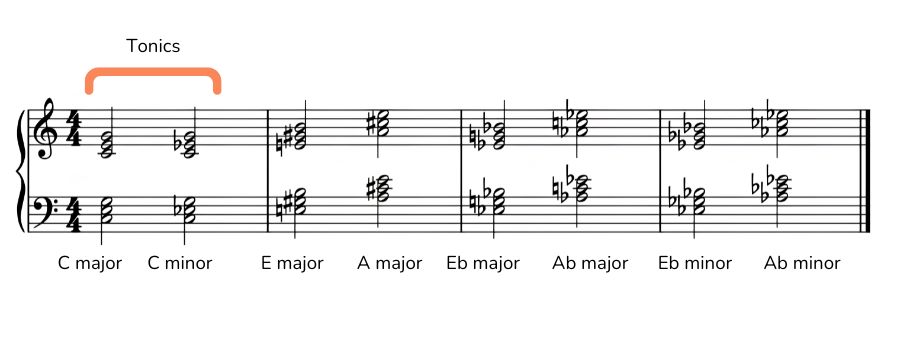
Here are all the chromatic mediants for C major/minor, providing a decent range of keys to move to!
This video explains is well:
Smooth transitions
A defining feature of chromatic mediants is that they share exactly one common tone between the two chords. So for example, when moving from C major to E major, the note ‘E’ is common to both chords. When moving from C major to Ab major, the common note is C. This note can be used as a ‘pivot’ and provide a smooth transition between the chords.
Classroom Application
I’ve found that using chromatic mediants as a harmonic technique is particularly effective for students completing free choice briefs that require a distinct change in setting or mood. The device is found in many film scores (see below) and the great thing is – they’re not difficult to use!
Moving directly from the tonic major to a major chord built on the flattened sixth can provide a sophisticated – and perhaps unexpected – move into a new section, as shown below:

Example
Here’s a simple example moving from C major to A flat major:
Here are two classroom tasks for students to try:
- Improvise – on keyboards start with a C major scale, with a C major chord held beneath, and move in turn to each of the keys shown in the box above (E major, A major etc.). This gets students used to the sound and the atmosphere created.
Move to a DAW and try this again using string tracks for a more expansive feel. - Map it out – as a technical exercise, ask students to work out the chromatic mediants for a given tonic (not C) and write them out. They can use the box above, with C major and minor as tonics, as an example.
I hope you’ve found this article useful. In the next two parts of the series we’ll look at Augmented Sixths and Diminished Sevenths.