Welcome to the final part of our 4 part series covering Advanced Harmonic Vocabulary. If you need a recap, here are the links to the previous articles.
When assessing A-level composition portfolios, examiners often highlight a common hurdle: students can struggle to move between distant keys. While modulating to closely related keys (such as the dominant or relative minor) is a fundamental skill, modulating smoothly to a more remote tonal centre, requires a higher level of harmonic sophistication.
To address this challenge, students can use the diminished seventh chord. This ‘chameleon’ chord uses its symmetrical structure (see box below) to bridge distant keys. If they can successfully use this device, along with the other techniques covered in this series, students’ compositions will show greater levels of skill, be more musically satisfying and meet the highest tier of exam board mark schemes.
In this post we’ll look at what the diminished seventh is and how it can be used to modulate, create tension and add harmonic colour in a composition.
Diminished seventh chord – what is it?
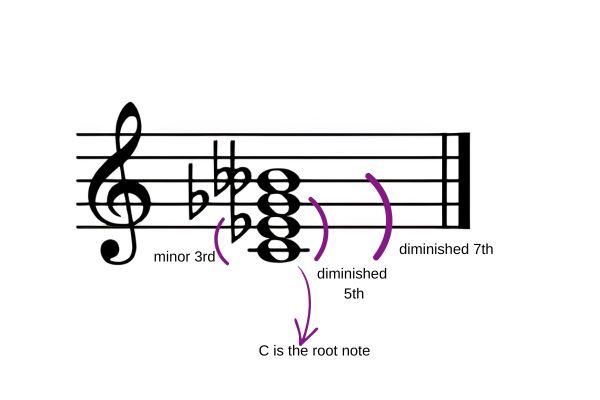
A diminished seventh chord is a four-note chord made up of a diminished triad and a diminished seventh. If you look closely you’ll see that it’s constructed entirely of stacked minor thirds:
- A minor third
- A diminished 5th
- A diminished 7th
A C diminished seventh chord looks and sounds like this:
Explore more of the theory behind the diminished seventh chord here.
The ‘chameleon’ chord
A diminished seventh chord is versatile – because of the symmetrical structure with the stacked minor thirds, the root can change. This is really handy when it comes to modulating because the notes can be enharmonically ‘respelled’ if required (e.g. an E flat can be a D #), and resolve to different keys.
So, just like a chameleon, the diminished seventh chord can blend in wherever it finds itself!

One chord, several resolutions…
Here we have a diminished seventh chord built on D#. By using each of the notes of the chord as a root, it can resolve by a semitone to four different minor keys. Three of these are given below:
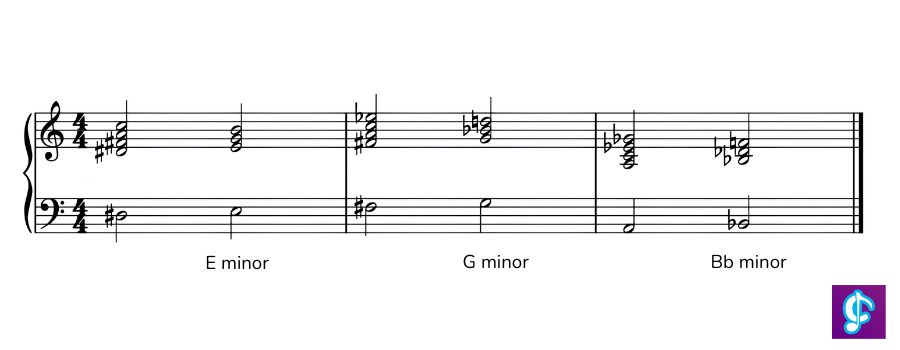
Notice how the diminished 7th chord is resolved by the top and bottom (bass and soprano) notes moving inward by step.
Building tension
Beyond its utility as a modulatory pivot, the diminished seventh chord is one of the most effective tools for creating harmonic tension. For an A-level student, understanding why this chord sounds tense allows them to use it with purpose rather than at random.
In traditional tonal music, tension is created by interval dissonance – specifically, the tritone. A standard dominant seventh chord contains one tritone (between the 3rd and 7th degrees), which drives the chord forward toward its resolution.
A diminished seventh chord, however, contains two interlocking tritones (have a look at our diagram in the first box – can you see the C-F# and Eb-A ?). Because the chord is comprised of these unstable intervals, it lacks an ‘anchor’ and the ear wants it to resolve, thus creating tension.
Adding colour and emphasis
We’ve looked at using the diminished 7th chord as a means of moving to a remote key and to build tension. Another way of using this chord is to highlight a moment, for example in a song, the diminished 7th could draw attention to a particular word. It can also add harmonic colour to a chord progression that might otherwise feel bland.
Classroom Application
Here are two tasks you can use in the classroom to get students using the diminished seventh.
- Build and play diminished seventh chords: first, get students making diminished seventh chords ensuring that they include all four notes with the minor third intervals. They can do this on paper, on a notation programme or using a DAW.
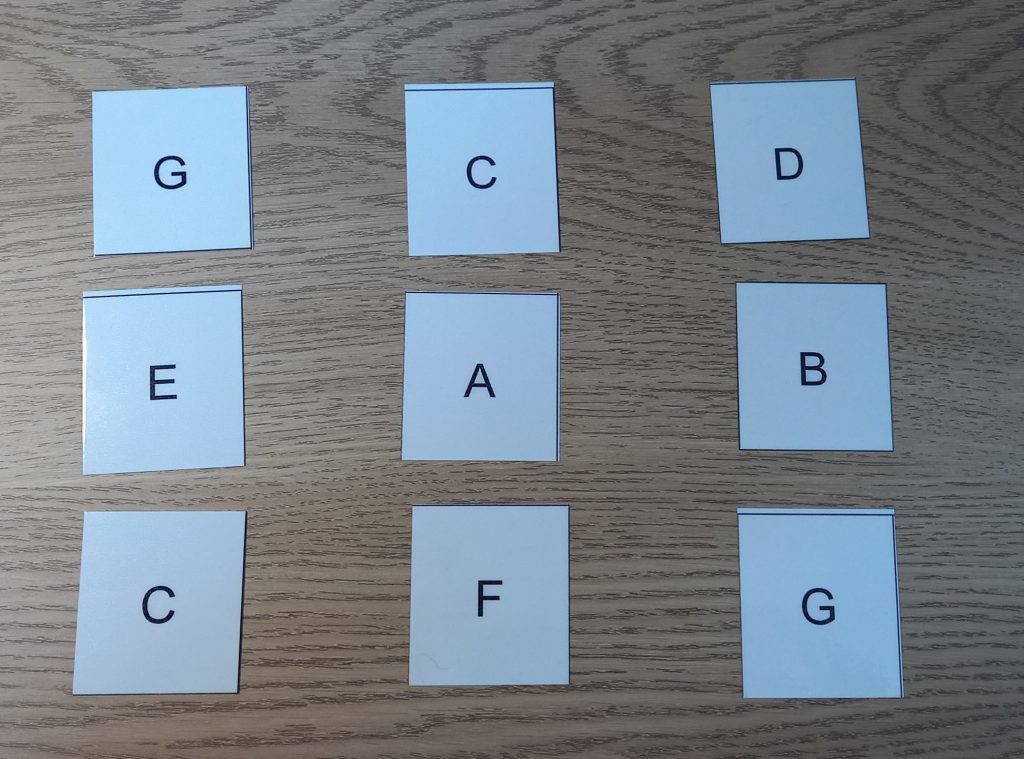
I like to use chord cards (see pictures below) where students have laminated cards of letter names and arrange them on the desk to build the required chord. (I used this on my CPD training sessions, and they were so popular that I created a Composing Activities Resource Pack to download. N.B the cards in the pack are more visually attractive than the ones shown below!).
You can use this same idea to build diminished seventh chords. It encourages students to think first about the letter names so that they’re counting a third above each time, and then making them minor (not putting down G b instead of F# for example). - Resolve the chord: set a challenge for students to resolve one of their chords to two or three minor keys, using the example above as a model. They should choose notes in the chord as a root and move up by a semitone to the new minor key.
Chord cards: root position
Now make the chords minor
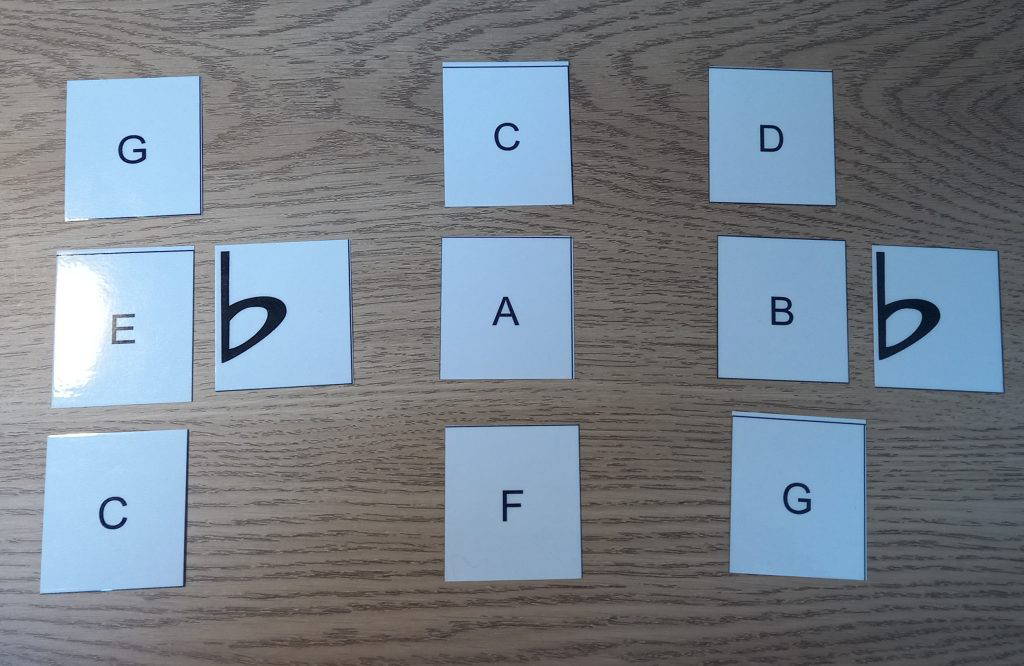
Now make C augmented and G diminished
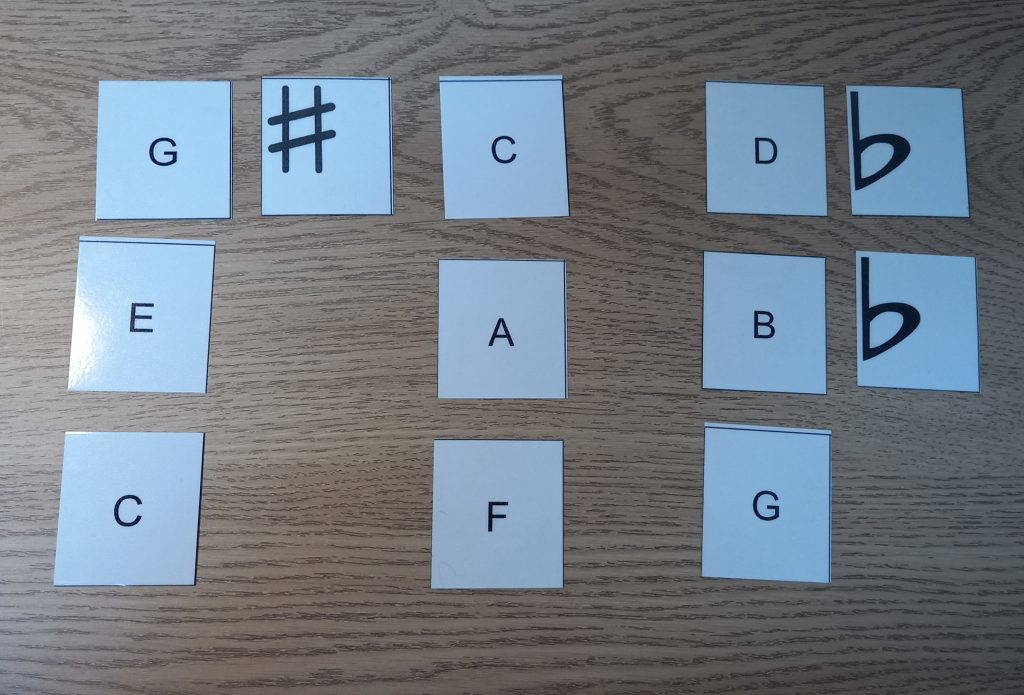
Further listening
These pieces all use diminished sevenths and can be included in your classroom examples:
- Fantasia and Fugue in G Minor, BWV 542 by J.S Bach
- Imperial March from Star Wars by John Williams
- Bohemian Rhapsody by Queen (see right)
And finally…
I hope you’ve found this series useful (do check out the posts on Chromatic Mediants and Augmented Sixth chords) and have some ideas to help your advanced students to improve their harmonic techniques in composition.
We’re currently working on some advanced composition materials so watch this space!