In the previous article in this 4 part series, we took a look at Chromatic Mediants. In this article we’ll move on to another tool: Augmented Sixths.
Augmented sixth chords – what are they?
Augmented sixth chords are highly effective tools for structuring musical tension at cadence points.
Technical definition
An augmented sixth chord is a predominant chord built on the flattened sixth scale degree of a key. Its defining characteristic is the interval of an augmented sixth formed between the bass note and an upper voice.
All types of augmented sixth chords contain the scale degrees: flattened 6th and sharpened 4th.
In the key of C minor (or C major), the flattened sixth scale degree is A flat, and the augmented sixth above is F sharp. When resolving, these two outer voices move by semitone in contrary motion.
There are three main types of augmented sixth chord: German, Italian and French.
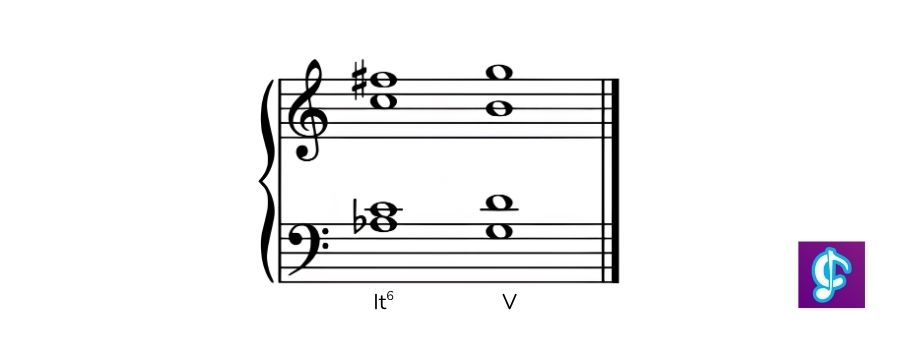
Italian sixth
Consists of the root (Ab), third (C), and augmented sixth (F#).
French sixth
Contains an additional second scale degree (Ab – C – D – F#), introducing a whole-tone dissonance.
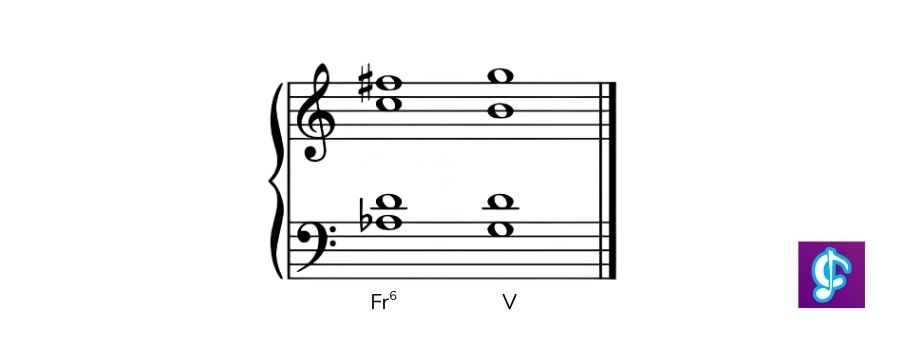
German sixth
Includes a minor third above the bass (Ab – C – Eb – F#).
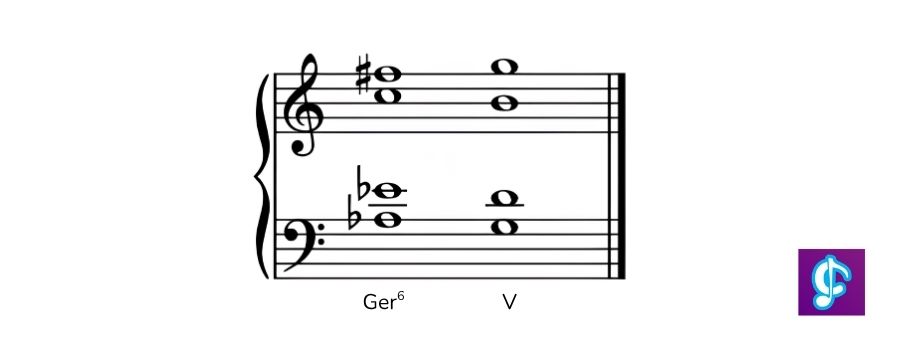
Parallel fifths solution…
One way round the parallel fifths issue is to slot a Ic chord in the middle:
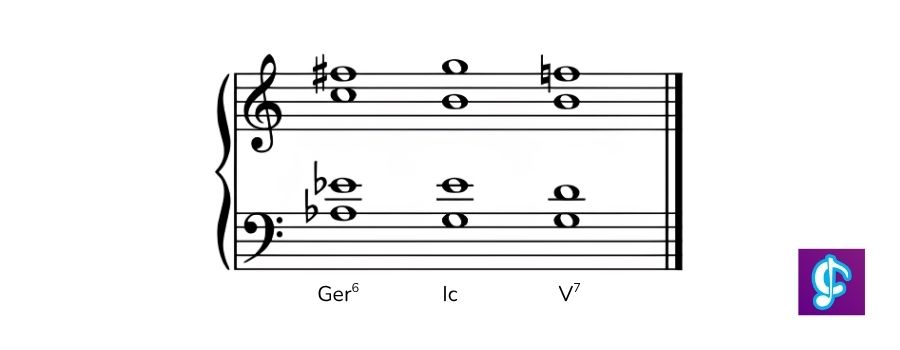
German sixth – what do you notice?
If you know you’re 4-part harmony rules, you’ll have spotted the parallel fifths in the two lower voices:
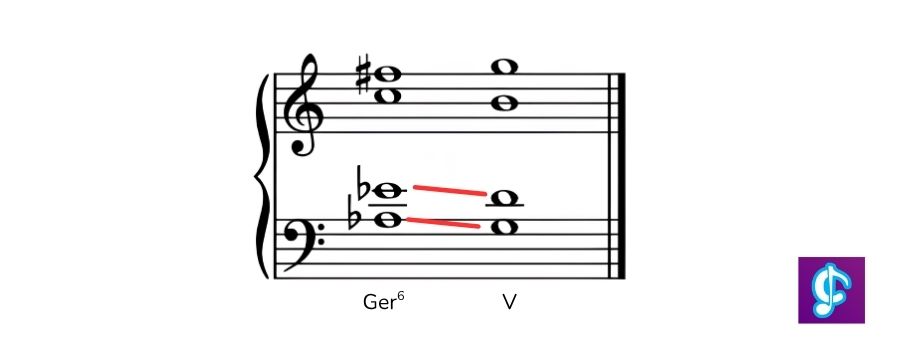
Scroll down and look left to find out how to avoid these illegal parallel fifths!
Voice-leading rules
There are specific rules for each type of augmented sixth. Here I’ll just outline the rules for the German sixth – you can learn about the other types of augmented sixth here.
1. Chord notes
As we learned earlier, the German augmented sixth chord consists of 4 notes: the flattened sixth, the tonic, the flattened third, and the raised fourth. Make sure these four notes are all present in the chord.
2. Resolution
The defining feature of any augmented sixth chord is how the flattened sixth and sharpened fourth resolve. They must move outward by step into an octave on the dominant note.
- Sharpened 4th: must resolve up by a semitone to the dominant.
- Flattened 6th: must resolve down by a semitone to the dominant.
3. Beware parallel fifths
The German sixth contains a perfect fifth between the flattened 6th and the flattened third. If you resolve it straight to a chord V, those two notes will move down together and create parallel (consecutive) fifths.
To avoid the parallel fifths, move to a cadential 6/4 (2nd inversion chord before chord V at a cadence) – see earlier example.
Application
These chords serve as excellent harmonic pivots before significant structural events, such as a new section. Instead of approaching a cadence via a standard subdominant chord, students can use an augmented sixth to build anticipation.
If students are practising writing cadences, build in the augmented sixth and encourage them to use it in their free composing work. They’re not just for ‘classical’ compositions either – see the ‘further listening’ box below for a wide range of examples
If you’ve found this article useful do have a look at our final article in this series: Diminished Sevenths.