Planning a meaningful music cover lesson at short notice often feels like a balancing act between keeping students engaged and ensuring genuine curriculum value. This post provides a curated selection of good quality, YouTube-accessible video resources ideal for 11–16 year olds, covering everything from the cultural roots of hip-hop to the complex mechanics of film scoring. For each video I’ve included a short summary, the duration and some suggested questions for students to answer or discuss.
Disclaimer: always watch the video yourself first before setting it for students to watch, to ensure that it is appropriate for your setting.
1. Hip Hop: a Culture of Peace
This documentary was originally developed as a master’s thesis in International Peace & Conflict Resolution. It explores hip-hop as a transformative global culture rooted in the principles of peace, unity, and social justice, moving beyond mainstream stereotypes to highlight its potential as a tool for community building and education.
Duration:
32:28
Questions for students:
- (Before the video) What do students think the “goal” of music is. Is it just to sound good, or can it change the world?
- What are the ‘four elements’ and the ‘fifth element’?
- The video mentions the Hip-Hop Declaration of Peace (presented to the UN in 2001). Ask students to write their own ‘Musical Manifesto’. If they were starting a new genre of music today to help their community, what would its 3 main rules be?
2. The Art of Sound in Movies: What is a Foley Artist?
This video offers a fascinating behind-the-scenes look at Foley artists, the creators who perform and record everyday sound effects in post-production to make films feel immersive and realistic. It demonstrates how these artists use an array of bizarre physical objects – from celery stalks for breaking bones to old shoes for specific character gaits – to recreate the subtle textures of movement and environment that on-set microphones often fail to capture.
Duration:
27 minutes
Questions for students:
- Who is the “Father of Foley”? (Answer: Jack Foley)
- What are the three main categories of Foley sound? (Answer: Feet, Moves, and Specifics/Props)
- Why can’t filmmakers just use the audio recorded on set? (Answer: Microphones focus on dialogue; background noises like footsteps often sound “thin” or are lost entirely.)
- Name one unusual object used in the video and the sound it was meant to represent. (e.g., Celery for breaking bones, or a chamois cloth for squelching sounds.)
- How does Foley help an audience connect with a character? (Answer: It adds “weight” and personality to their movements, making the world feel real and lived-in.)
3. Jacob Collier: In the Room Where it Happens
This documentary explores the meteoric rise of the multi-instrumentalist virtuoso, tracing his journey from viral YouTube bedroom sessions in North London to winning multiple Grammys and collaborating with legends like Quincy Jones and Hans Zimmer. It offers an intimate look at his unique creative process, demonstrating how he uses advanced music theory and technology to transform his childhood home into a world-class laboratory for harmonic exploration.
Duration:
1:10:40
Questions for students:
- Name one piece of technology or ‘unusual’ instrument Jacob uses to create his sound.
- Jacob believes the audience is an instrument. If you were conducting a “choir” of your classmates, what is one simple sound or rhythm you would have them all do together?
- Does having “too much” musical knowledge (like Jacob’s perfect pitch) make music better, or can it make it too complicated for the average listener?
- Design a ‘Jacob Collier-style’ collaboration. If you could pick one modern artist and one classical or jazz musician for Jacob to work with, who would they be? Write 3 sentences explaining how those three different styles would sound if mixed together.
4. The Rise to Fame of Hamilton: One Shot at Broadway
This documentary explores the phenomenon of the musical Hamilton, detailing its journey from a concept album to a global Broadway hit. It features interviews with the cast, crew, and historians, focusing on Lin-Manuel Miranda’s creative process and how he blended historical biography with contemporary hip-hop and R&B. It is highly educational for students interested in songwriting, diverse casting, and how music can be used to retell history.
Duration:
59:07
Questions for students:
- According to the video, what three styles of music does Hamilton combine to create its unique sound?
- Where was Lin-Manuel Miranda when he first read the biography of Alexander Hamilton that inspired the show?
- Why did the creators decide to use a diverse, multi-cultural cast to tell the story of the American Founding Fathers?
- The video mentions that some songs took years to write. Which song is highlighted as particularly difficult to perfect?
- Name one way the documentary says Hamilton has changed how people think about “theatre” or “musicals.”
5. Sound of Cinema: 1. The Big Score
This video is ideal for a film music cover lesson. Composer Neil Brand explores the birth of the ‘Big Score’ – the lush, orchestral music that defined Hollywood’s ‘Golden Age’. He traces how European composers (like Max Steiner and Erich Korngold) brought operatic traditions to films like King Kong and Robin Hood, and how Bernard Herrmann later revolutionised the industry with his darker, psychological scores for Psycho and Citizen Kane. The documentary explains the technical and emotional ‘tricks’ composers use to tell a story through sound.
Duration:
1:13:49
Questions for students:
- Which city in Europe did the first great Hollywood composers come from? (Answer: Vienna)
- King Kong (1933): How did Max Steiner’s music help the audience feel about the giant ape? (Answer: It gave him “heart” and made him a character, not just a monster).
- What is a “leitmotif” as described in the video? (Answer: A short musical theme associated with a specific person or object).
- How did the music for Psycho differ from the ‘Big Scores’ that came before it? (Answer: It used only strings and was much harsher/sharper).
- Name one famous director and composer partnership mentioned in the video (e.g. Alfred Hitchcock and Bernard Herrmann).
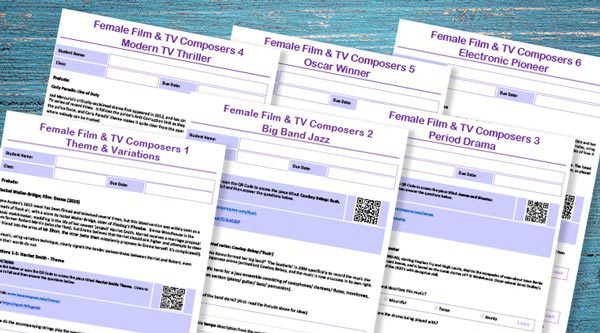
I hope these lesson ideas are useful if you’ve got to set some last minute cover. If your students enjoy the Hamilton and film music videos, why not take it further with our popular listening packs?