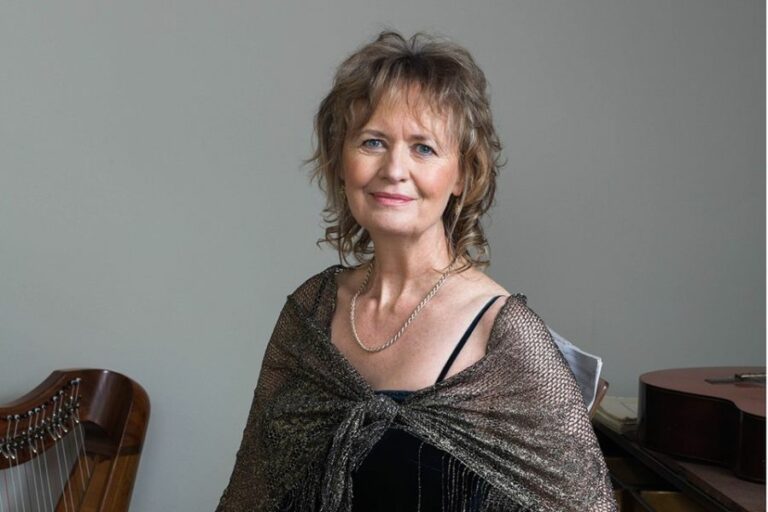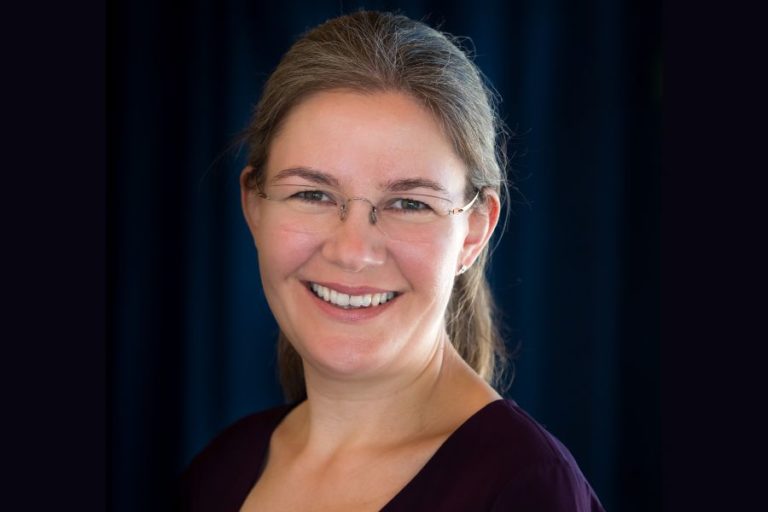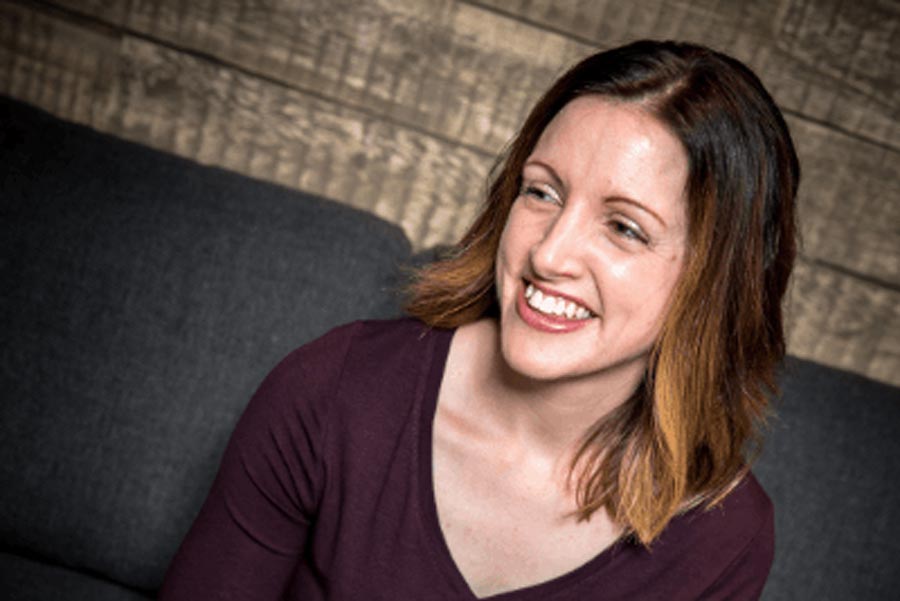
Sarah Nicolls is an innovator, composer and concert pianist. She was awarded the UKRI Women in Innovation award in 2023 and her ‘Inside Out’ piano was featured in The Times (January 9 2026).
Find your questions!
Sarah Nicolls, Winner UKRI Women in Innovation 2023-24
Can you tell us about the ‘inside out’ piano?
The inside-out piano is, at the moment, a hacked grand piano, which I invented so that I could more easily play the strings. I love the sounds that you can make with the piano strings. You can make all sorts of amazing sound effects, but when you do it on a traditional piano, if you’re trying to do it on an upright, it’s very hard, because the strings go down to the floor under the keyboard, it’s impossible to reach them whilst also playing. On a grand piano, they’re there, but they’re awkwardly placed so that you have to lean over, lean inside, you might be standing on one leg because you’re trying to pedal with the other foot, the music stand is in the way, and for the audience it’s invisible. And so I thought: I’ll change the shape of the piano to get to the strings more easily.
That’s fascinating! How did you begin to reinvent the piano?
I sort of knew what I was doing and why I was doing it, but then what’s fascinating about making instruments is that when you set about creating a new thing, it’s really only when you’ve made it that you find out what it does.
And there were various surprising side effects. One was that it’s on a metal frame and the metal frame has a pivot point because it was designed so that I could get the piano up and down on my own. I have a ratchet, and I just ratchet backwards and forwards to make the frame go up from being flat into this kind of upside down V shape, which is brilliant.
It means I can have 200 kilos of piano in midair on my own. But what I didn’t realize was that having a pivot point means I’d have a swinging piano!
I went to collect it in Paris. And Pierre said, “by the way, it swings” and I said, “sorry, what??” And that threw me into a whole different creative journey, making shows about life and death and reimagining the piano very much as part of the domestic scene.
Can you tell us more about one of your shows?
So in my Moments of Weightlessness show, I get the piano in all sorts of different positions.
And I think being irreverent with the piano is a theme, because once I had a piano that could swing and that I could put on a diagonal with very little effort and I could lie against the keyboard whilst also sitting on the floor, it just changed the whole thing. It threw everything up into the air in a very useful way.
And another side effect was that people said, “oh, it’s like a space-saving grand piano”. And I thought, “that’s interesting”. I’d always wanted to make a light piano because I just think pianos are heavy and it’s annoying. They just shouldn’t have to be that heavy!
Because, you know, obviously I’ve moved pianos quite a lot. But, you know, other people move pianos too. And so it’s all come together now in the current project where I’m working with engineers to make a lightweight vertical grand piano.
The aim is that I could make enough that they could be sold all over the world and everyone could make music in a new way, which is incredibly exciting.
That’s really exciting. And you’ve been recognised as a UKRI ‘Woman in Innovation’ – what does that mean to you?
I was given a plaque for the Women in Innovation award. I thought that a plaque can be a bit dull. Normally it just says something like “Mr. Smith lived this time, did this thing, died this time.” And I thought: my plaque was going up in an education place and would be better if a plaque has a message for the children that are walking past. It’s about passing it on. It’s about inspiring.
So on my plaque, I wrote: “Find your questions”, because that’s what I think life is about. It’s about seeing the things that you see that might need a bit of change and then going ahead and changing it.
“Find your questions” is sort of becoming a bit of a mantra of mine.
And how do you find that mantra helpful on your creative journey?
It’s a very useful little phrase, because it doesn’t dictate that you’re even going to find any answers. Fundamentally you don’t know what you’re going to find when you start asking, and you might find more questions, you might find an answer, you might find a whole load of trouble. You might find that you have to suddenly climb into completely different worlds which are really difficult to deal with, that you have to learn the language of, that you have to manage relationships in and navigate politically and you might have to stretch yourself in ways that you never knew were possible.
Your professional career as a pianist is now moving in new creative directions. Can you tell us about that?
The transition into composition from being a classical pianist is a very slow journey of acceptance, because the music that I write is very different to the music that I played. I played very complicated music that was very difficult to listen to. Then I made my first piano – it was an upright piano – and I hacked it apart and put it back together. I basically just got the strings and turned them 180 degrees to put them above the keys. This had a rather dramatic effect. It meant that the bass strings were now on the right of the keyboard, and the treble was on the left. And so suddenly the whole piano was literally upside down in timbre. It was mind-blowingly difficult to get my head around, because top A was where bottom A should be, and the only notes that were what they said they were on the keyboard were A and E flat, so every A and E flat was an A or an E flat, and everything else was wrong.
The total breakage of the system which I had played since I was three sort of ‘rebirthed’ me as a musician because I’d worked towards playing very difficult, complicated music, loving it, and suddenly all I could do was basically find a note and find another note and say, ‘well these two notes sound nice together’. And it was a doorway through which I could go to re-enjoy simple things: major thirds, fifths, octaves, because I was suddenly a grade one pianist all over again.
What have you learned / are learning as a composer?
Being creative is being open to what happens and about discovery. The journey into composition from being a sort of ‘meticulous interpreter’ is a lot about interpretation, and actually a fair amount of imitation – I would listen to Alfred Brendel and try to copy him when playing Beethoven. Composition is completely different. It’s about listening to your own voice and giving voice to it.
It’s also about trust. It can take a long time to find the quietness in your ego to just admit that what you want and instinctively feel is the right thing.
And another interesting thing I would say is that as I’ve got older and I meet people who are sort of experts at a later stage of life, shall we say – people who are top of their game, they talk about feel a lot.
It’s like you’ve absorbed everything and then it becomes instinctive.
What do you think our young people can learn from this?
I think it’s good to give children the trust and the space to learn the building blocks you need to learn and then to understand the parameters of possibility because they are much wider than probably most curricula might teach. You can just hit a piano string with a timpani stick, why not?
If I show a student my piano, they’ll play the keys, and then I say, “if you want, you can use the stick to hit the strings”, and they’re mind is blown! And then they experiment a bit more and see what they can do.
Trusting in their own intuition is important: if they want to play one note 300 times, that’s composition.
Do you think there’s a way of ‘reframing’ composing that might encourage them to take risks and stretch their creativity?
When I was taught GCSE, my pieces were horrible. I definitely wouldn’t want to have listened to them in a concert! If somebody had said to me: “what do you want to communicate with the world through sound?” that would have been a much better question.
I would have been really interested in that. I think if they had said, “follow the piece through in the way that your imagination takes you”, that would have been far more inspiring.
Don’t worry about sonata form or whatever. Just where do you think it should go? If you play this note, what do you hear is the next note?
I guess the tool we want to give them is to learn to create in sound. That’s what composing is, and what an amazing gift. And it’s all a big kind of washing machine, the creative experience. You need to feed it with different things and let it all flow. Having the power to write something down that then creates sound that can be communicated without any words to somebody else. It’s amazing.
Through your compositions ‘Twelve years’ and your Snape Maltings residency, you addressed climate change. Can you share more about these projects?
I had met Maya Bugge at the Cheltenham Jazz Festival, and we got together for this week-long creative project at Snape Maltings.
She had been quite inspired by my ‘12 Years Project’, which was obviously a very different affair [to creating something from scratch in 5 days], because it was solo composed and written down properly. For ’12 Years’ I interviewed the top 10 climate scientists around the UK and really thought about the narrative shape of what I was giving to the audience and how they might feel by the end of it. Even down to the detail of how the programme notes were and which were for reading afterwards.
It was a very big research project with a controlled environment to deliver something. One audience member said that they had known about climate change but never felt it before, which was some of the best feedback I could have received.
For the Snape Maltings project, it was a more ‘rough and ready’ version of the same thing.
Maya and I like to make each other laugh, so we decided to set about making a 45-minute stand-up comedy piece about climate change.
It does get really heavy, but we were also trying to have this ridiculous concept that we called a meeting and the climate change crisis needed to be solved in that 45 minute meeting.
Many people, I think, shrug their shoulders and say, ‘I don’t know what to do. What can I do?’ And just acknowledging that’s one of the feelings rather than being didactic or lecturing, can be helpful. I think the advantage of talking about big topics in this creative way is that you’re not saying, “I’ve got some answers and I’m going to tell you what to do.”
Which composer(s) working in experimental music has most influenced your desire to push the boundaries of what a piano can be or what a piano can do?
The first names that come into my head are John Cage and Henry Cowell. Henry Cowell because of Banshee and the physicality of it, the fact that normally it’s not done very well – two people come on stage and the piano page-turner sits down at the keyboard and puts the pedal down and then the pianist goes around to the curve and does all this playing.
But it’s normally that sort of, Oh, this is a funny classical music joke. Just come and press the pedal. I hate that kind of naff humour! But obviously Henry Cowell wasn’t suggesting the humour. He was just saying: “this sounds amazing, let’s get involved with some of this.”
And his Aeolian Harp (1923) is also great. It’s such a nice idea: put the notes down, strum the chords. It’s a beautiful effect.
There’s also the minimalists, like Steve Reich and there’s beauty in composers like Satie. Then there’s Fred Hersch, who I think is brilliant. He does inside piano, just mad levels of preparation. And it’s beautiful music.
And as a woman working in innovation, composing and the world of pianos, are there any female composers you admire?
Yeah there’s not enough women! I like Polish pianist and composer Hania Rani, also Kelly Moran and I love Anna Meredith. Laurel Halo is also on my playlist. There’s Poppy Ackroyd, so many creative brilliant women working in new music in the UK, like Lore Lixenberg, Claudia Molitor, Zoe Martlew and I love listening to synth legend Susanne Ciani.
There’s recently been an increase in the popularity of the piano* – why do you think that is?
I think it’s a great instrument and I think that people want experiences. They like touching something and making sound, you know, a basic kind of human urge, perhaps. But it’s also about human connection. The other day we had a gig here and it was folk trios. I was so moved and it was just the simple act of being in a room with 50 people, listening to 30 people playing instruments.
Communicating through music, which doesn’t have words, isn’t telling you what to think. I felt like I was being reminded how simple it is to be a human. Just to have ears and to be able to listen and to feel engaged in somebody else expressing something. It’s ridiculously powerful.
*See article from Artmaster.
And how important is that, with the rapid evolution of AI?
We still need that human connection and engagement. And that’s something that AI can’t give us, although it can pretend to. Of course, it does things quickly, can be a great work companion and we can learn a lot, but we shouldn’t forget that there’s all the other real dimensions of being human and that’s invaluable. So I enjoy the new technology but remember that some things that have been around for a long time have immense value.
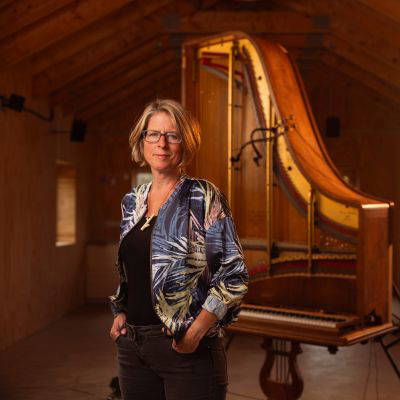
About Sarah Nicolls
Sarah Nicolls is a pioneering pianist, composer and inventor.
Her compositional life began when she changed the shape of the piano to bring the strings within reach, to create layers of textured sound. She built her first ‘Inside-out Piano’ in 2008 and in 2014, with Pierre Malbos, re-shaped an Erard grand which became a sculptural feast, standing 2.5m tall.
Sarah’s company First Light Pianos, supported by Innovate UK, is now making this shape into a lightweight piano using Formula 1 technology, collaborating with engineers including Atelier One, who engineered World Building of the Year ‘Gardens by the Bay’ in Singapore.
She has also built a virtual software instrument – a sampled mirror of her ‘Inside-Out Piano’ for anyone to use at home – available at Song Athletics.
Sarah has made shows about motherhood and climate change, chosen as Guardian 2020 Top Pick and featured on BBC 4’s Front Row. She toured Matthew Herbert’s 20 Pianos project, is regularly broadcast, was resident at Artangel’s Library of Water in Iceland and has premiered multiple piano concertos.
Sarah is a Visiting Senior Research Fellow in Music and Engineering at King’s College, London.