
In the previous section we explored what makes a successful melody, and listened to some well-known tunes. It’s now time get composing. Before we launch straight in, we’re going to do a couple of short tasks called “Continue the melody”.
In this lesson we’ll cover:
- Working in a major key
- Continuing a melody
This lesson is a little longer than the previous sessions, so you might wish to go through the material in stages.
Working in a major key
In this lesson we’ll focus on melodies in a major key; the next lesson will look at minor keys.
Read or listen to the intro below:

Continuing the melody
Below are the first bars of some melodic phrases and you’re going to try and continue each one for another two bars. You can do this by either writing it out on manuscript paper, playing it on your instrument or inputting it into your preferred notation programme / DAW. Each melody includes the audio so that you can play it back.
Tips for success
- Identify the key first
- Aim to finish on the tonic (e.g. in C major the tonic is C; in G major the tonic is G and so on)
- Can you use any of the given excerpt in the bars you are adding?

Practical Task 1
Continue each melody below for a further two bars.
Remember to identify the key of each one before you start.
You can tackle this practical task either by reading the staff notation, listening to the audio and writing down your answer. Or you could do it ‘by ear’ – listening to the audio and humming / singing / playing how it could carry on.
Task 1
Have a look at and listen to the example below. There are two bars of melody, and you need to add another two bars to make it a four-bar phrase.



Why is this answer better?
- Bar 3 uses the same rhythm as bar 1
- There is a better melodic shape – Bars 1-2 ascend, then bars 3-4 descend.
- It finishes on the tonic, D. This makes the phrase sound complete and also gives us a clear sense of key.
This is melody works well and has a good shape, though perhaps it doesn’t open up the range quite as well as the first answer.
Practical Task 2
Let’s have another go using the purple box below.
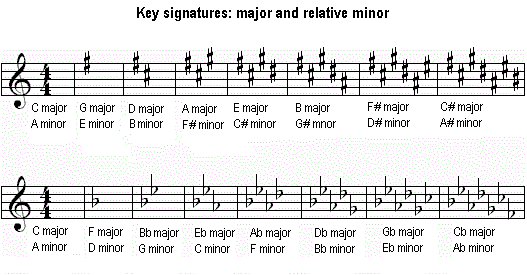
In the first example we learned that establishing the key is important. The key should be identified before we begin. Remember that each key signature has a major and minor key.
Key Signature Chart
If you’re not confident on key signatures, don’t worry! Here’s a key signature chart.
Task 2


Key = B flat major. This answer ends on the dominant: F.

This answer ends on the tonic: B flat, making the end of the phrase sound more final.
By looking at the chart we can see that the key with 2 flats is B flat major.
Final task
Mini exercise
Have a go at completing the melody given below, in the same way that you did the previous tasks.
Remember the elements that make a good melody:
– Clear sense of key (aim to finish on the tonic)
– Good melodic shape (think about the direction of the tune)
– Repetition (what can you use that has already been given, e.g. rhythm?)
– Sense of phrasing
Continue this melody…

We have now looked at continuing an existing melody in a major key. In the next lesson we’ll explore minor keys and then move onto composing a melody from scratch.
Let’s Go!
Click the MARK COMPLETE button below and move on to the next lesson.