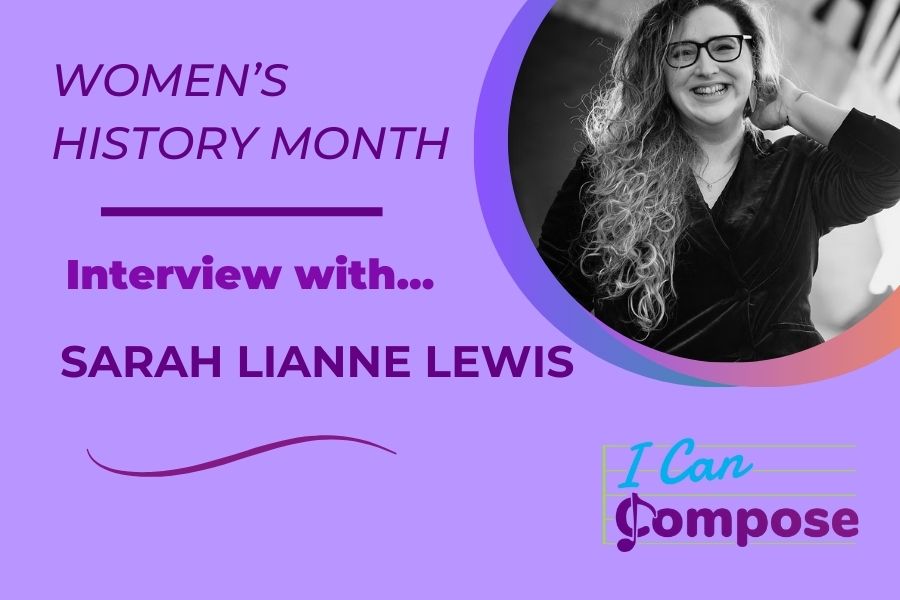
Sarah Lianne Lewis is a trailblazing Welsh composer whose music explores the delicate beauty of “unexpected sonorities.” Historically recognized as the first female Composer Affiliate with the BBC National Orchestra of Wales, her award-winning work often bridges the gap between the orchestral world and atmospheric electronics. Informed by her perspective as a disabled woman, Sarah’s atmospheric compositions are featured regularly on BBC Radio 3 and performed at major festivals across Europe. Today, she shares her insights on creativity, education, and the future of composition.
You made history as the first female Composer Affiliate with the BBC National Orchestra of Wales. What did that milestone mean to you personally, and what do you hope it signals for the future of British classical music?
Becoming the first female Composer Affiliate with the BBC National Orchestra of Wales was a huge milestone for me. On a personal level, it felt like a recognition of my work up to that point, and at the same time, it also highlighted the fact that there had never been a Welsh woman appointed to a resident composer position with the orchestra. I’d like to hope that it signals a continued shift towards inclusivity within the programming of orchestral music.
Growing up, there was a noticeable lack of representation of female, non-binary and/or disabled composers within classical music canon – particularly looking at larger orchestral works. Even looking at the past BBC NOW resident composers, these were all white men. Again and again, directly or indirectly there was a clear message – classical music was the sphere of white men. Early development opportunities doubled down on this; I was often the sole female in the room filled with male counterparts.
The richness of British music comes from the fact that there are so many different people, with a wide variety of influences and stories. Younger composers need to have visible role models that they can identify with in the industry. There’s lots of work being done to rectify this imbalance, but there is still much to be done.
The BBC NOW ‘Grace’ series (2023) highlighted Welsh pioneer Grace Williams. Which historical female composers have most influenced your own musical language?
Kaija Saariaho, Lily Boulanger, Jennifer Walsh, and Rebecca Saunders are some of the first female composers I remember discovering, and each have such a distinct musical language and approach for how they write music. The huge variety in musical style, and the careful intention each of them had with their music taught me to believe in my own voice, and be unapologetic about my own music. Some composers that I’ve been enjoying listening to at the moment are Samantha Fernando, Anna Meredith, Caroline Shaw, Angharad Davies, Simmy Singh, Andrea Tarrodi, and Julia Wolfe.
Your RPS Award-winning piece letting the light in was written for a solo pianist and explores themes of motherhood and disability. How did you approach writing for a single instrument to convey such deeply personal and complex themes?
‘letting the light in’ was written in a very vulnerable, personal moment of my life. I was only a few weeks postpartum with my first son, in a fog of exhaustion and joy, whilst also reflecting on a pregnancy loss we had experienced immediately preceding him. In those quiet night hours, life felt both fragile and hopeful at the same time.
I wanted the piece to have an element of this wonder and simplicity, but also an otherworldliness to it. The medium of solo piano lent itself well in this moment for writing; it’s the instrument at which I first sat and began to learn music as a young child, and it has such a breadth of emotion within it. There’s also lots of opportunities to explore different sounds away from the piano keys. I decided – with Siwan Rhys (the pianist)’s input – to use a small selection of ‘prepared’ notes within the piano; these formed an integral foundation of the piece’s harmony, and combined with the ‘ordinary’ notes, created a soundworld that was evocative of the hazy sleepless nights.
Do you have any advice for students who are experiencing a creative block during difficult times?
The most simple answer: Don’t be afraid of it if it does happen. I’ve experienced a significant creative block a few times in my career already, and I imagine I will experience them again multiple times in the future! I have found for myself that it can be linked to personal events, or it can stem from a self-imposed uncertainty or lack of confidence writing for an instrument that is unfamiliar. I’ve found it helpful to return to listen to works that I love; listening to music written by others that inspires me, and also revisiting some of my own music that I feel has been some of my strongest output. Sometimes this can be a gentle reminder of why we do what we do, and a combination of gentle listening and reflection can create space for a tiny spark to begin growing into a small idea, which then may develop into something more substantial.
Music by Sarah Lianne Lewis
Several of your pieces are inspired by nature (e.g. Salt-Starred Waters for solo flute and Four Bird Songs) How can students use poetry or nature as a structured starting point for a new piece?
I often use poetry as inspiration for composing; the structure of a poems can be used to create structure in music, even if it’s an instrumental piece that does’t use text. For Salt-Starred Waters, I had some a wonderfully vibrant written prompt given to me detailing a specific childhood memory of adventuring in a boat on the Scottish coast. I sat with the text for a while, and began imagining the sounds of the water: The waves, the gentle rocking of the boat, the glowing plankton in the water, and how this could translate as musically on the flute. I used soft repeated figures to represent the ebb and flow of the water, and tremolo and air tones to represent the wind. This piece in particular is non-linear: It’s made up of musical cells (like Terry Riley’s ‘In C’), which the performer can use to choose their own journey – and time taken – through the piece. Purely coincidentally, the flautist I was writing the piece for (Nevis Ensemble’s Gabriela Jaros) has chromesthesia (a version of synesthesia, a phenomenon where sound involuntarily evokes colour, shape and/or movement in people’s minds), and she was delighted that the material I’d written for the piece was several shades of blues and greens for her; giving her an added layer to the water-inspired music on the page.
Four Bird songs uses four poems by Welsh poet as a direct inspiration, but in my piece ‘the blue and the dim and the dark’ (written for double string quartet), I used recordings of birdsong, and transcribed the fragments of melodies, which created the basis of the piece. These melodic fragments of birdsong were short and unpredictable, subtly changing in length and rhythm each time they were repeated, just like the original bird calls I recorded in my local area.
Why do you think it’s important for student composers to workshop ‘malleable’ ideas with live performers?
Workshops are incredibly valuable for us as composers; they’re a space where we can ask questions about the instruments, explore whether our material or ideas work, and – particularly if the workshops are early / halfway through the composing process – we can take what we’ve learned and adapt our music. I’ve regularly brought very small fragments of material to a workshop with performers; I try out the material in multiple different ways (playing with dynamics, which instruments may play each line, tempo, layering different fragments one on top of the other etc). I make lots of notes about the sounds that I like / don’t like, and take what I’ve learned through the workshop to help shape the finished piece. Workshops should be a safe space to experiment with ideas before having a polished final piece of music – make the most of the opportunity to discuss ideas with the musicians!
How does working with young people and students influence your own professional compositional process?
I’ve had a lovely balance between my composing and teaching responsibilities recently. I enjoy working with my students to discover what fascinates them about writing music, and helping them discover new composers to inspire their journeys. Teaching also inspires me though! I’ve found that revisiting certain composing strategies or techniques can sometimes spark an idea for my own work, and not just serve as a jumping off point for my students. It reminds me to take a step back from my own music sometimes, and to look at what I’m creating with a more analytical head on, and helps me make decisions about pacing, use and development of musical material, and assess what I’m trying to communicate through the music.

About Sarah Lianne Lewis
Sarah Lianne Lewis is a Welsh composer of bold and imaginative contemporary classical music that blurs the boundary between acoustic and electronic sound. Described as “quiet and delicate” and “full of imaginative sonorities”, her music explores subtle intricacies of texture, engaging audiences in unique soundscapes and sonic atmospheres. She often writes about connection, climate change and the natural world, informed by a female disabled perspective.
Sarah was Composer Affiliate with the BBC National Orchestra of Wales 2020-2024; the youngest, and the first ever woman, to hold such a residency with the orchestra. Her work for solo piano, ‘letting the light in’, written for Siwan Rhys as part of Drake Music Scotland’s ‘Beyond Borders, Beyond Barriers’ project won the Royal Philharmonic Society’s Chamber-Scale Composition Award in 2025.
She has worked with a variety of performers, audiences and spaces; from textural orchestral works in concert halls, to contemplative chamber ensemble works in a late-night gin bar, to creating expansive storytelling soundscapes through silent disco headphones under the stars. She has worked with a range of ensembles such as the Royal Scottish National Orchestra, Quatuor Bozzini, the Royal Opera House, soprano Sarah Maria Sun, Blank Space Ensemble, UPROAR ensemble, and Nevis Ensemble. Her music has been commissioned by and performed in several UK and European music festivals including the Cowbridge Music Festival, Heidelberg Festival, CNCM gmem’s ‘Les Musiques’, Festival d’Aix-en-Provence, Archipel Festival, and the Lucerne Festival.
Sarah’s music has been performed in the UK, Europe, Canada, & Australia, and featured on UK, US, and European radio stations. Recordings of her music are available through the Birmingham Record Company, Ty Cerdd records and NMC Recordings.